

LAUTIE ROC OG: The Interference-Fit Spinner for Collectors Who Just Want to Spin

LAUTIE ROC OG:
The Interference-Fit Spinner for Collectors Who Just Want to Spin
Most fidget spinners — those classic three-armed pocket toys that peaked in 2017 and never actually went away — reward technique. Tilt wrong and the spin wobbles. The ROC OG doesn’t care how you hold it.

A working guide to LAUTIE’s catalogue, written for collectors who care about the difference. Most fidget spinners — those classic three-armed pocket toys that peaked in 2017 and never actually went away — reward technique. Tilt wrong and the spin wobbles. The ROC OG doesn’t care how you hold it. LAUTIE built the solution into the engineering: interference fit (a press-fit assembly that locks the bearing and eliminates wobble by design), an R188 bearing (a slim steel bearing prized in the hobby for long, stable spins), and a widened tri-arm body that self-stabilizes from the first throw.
This is the first interference-fit spinner in LAUTIE’s 2099 series. The mechanics show everywhere — narrower body profile, shorter lock spacing, a spin axis that holds without technique. Button interference locks, magnetic decorative accent plates, and OG stitching round out a deliberately old-school visual language pressed into machined titanium. LAUTIE’s answer to what a spinner should actually do is engineered into the structure itself. Read on for the mechanism, the material options, and who this piece is built for.
The LAUTIE ROC OG is the first interference-fit spinner in the 2099 series — titanium, three-arm, built around a press-fit assembly that locks the R188 bearing and holds the spin axis without any user technique. Button interference locks, magnetic decorative accent plates, and OG stitching carry the old-school visual language. Three versions dropped on the same Friday. For collectors who want a no-trick classic-format spinner with proper machining rather than another detent puzzle, this is LAUTIE’s answer.
Quick Navigation▾
The case for the old-school spinner
Here’s a question the EDC collector community rarely stops to answer out loud: what exactly is an “old-school spinner” — and is one actually worth owning today?
The short answer: an old-school spinner (also called a no-trick spinner, or simply a classic-format fidget spinner — a single-hand toy built purely for rotation) is a spinner you don’t need to learn anything to enjoy. No throwing tricks. No self-locking detents — those mechanisms that require weeks of learned technique to operate reliably — to navigate. You place it on a fingertip, give it a flick, and let it run. The entire experience lives in the weight distribution: how precisely the arms are balanced, how cleanly the bearing pulls the spin, and nothing else. That’s the whole format.
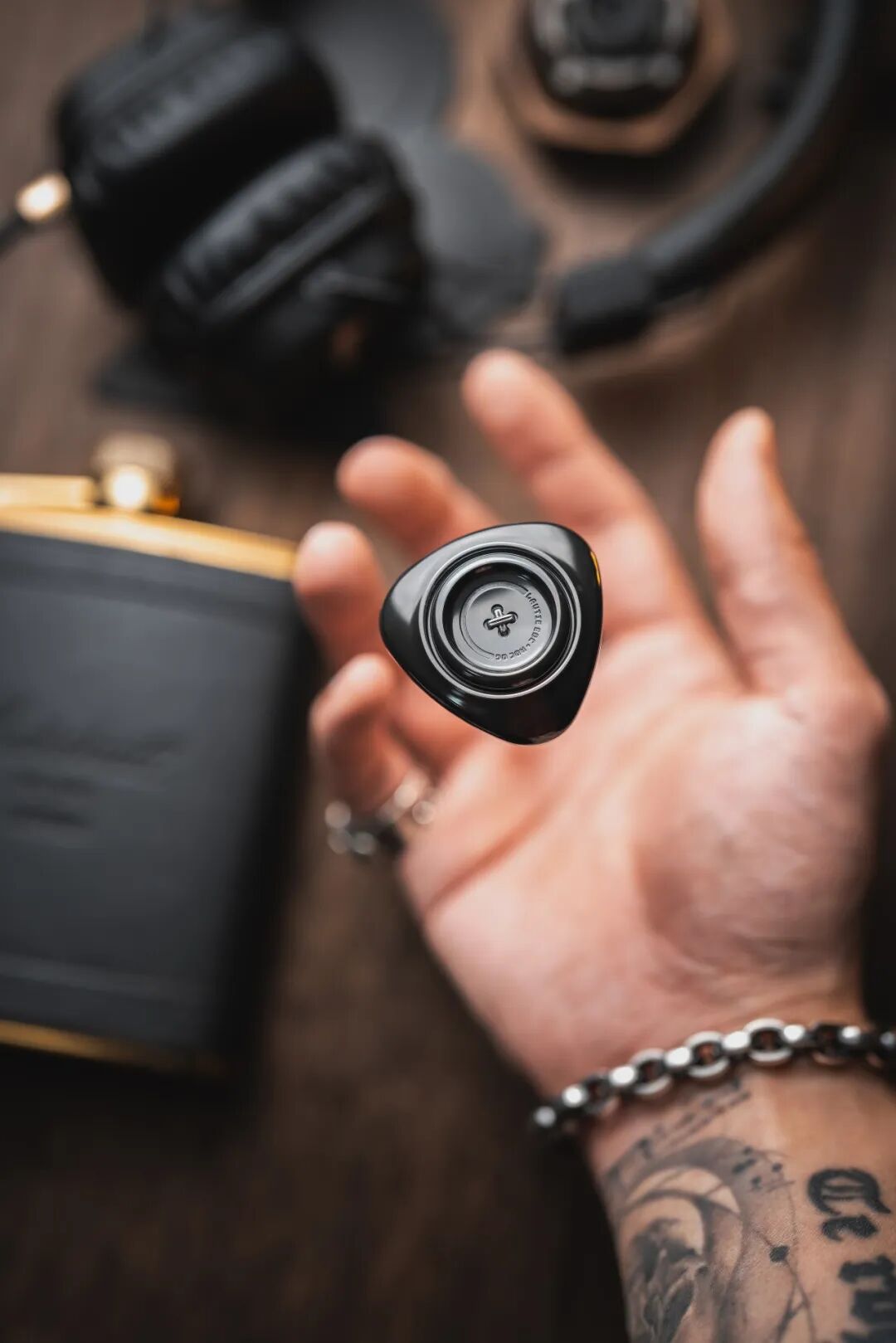
The Western collector community sometimes raises an eyebrow at this. No technique required — isn’t that just code for boring? The misread is equating simple with shallow. Think about a well-made fountain pen: no special grip, no training required, just pick it up and write. And yet it writes nothing like the cheapest ballpoint in a hotel room drawer. Quality expresses itself in the act, not in the learning curve. Old-school spinners work the same way — the barrier to entry is low, but the ceiling isn’t. A spinner with precise machining, dialed weight distribution, and a properly seated bearing feels completely different from a airport toy, even though both technically just spin. Material choices, bearing clearance, body thickness — all of it shows up in how the piece sits on your fingertip.
That’s the argument LAUTIE is making with the ROC OG. As part of the 2099 series, this piece doesn’t try to reinvent the spinner format. It goes back to the original question — can a seriously engineered, no-tricks fidget spinner still hold its own today? — and answers with machined titanium and an interference-fit bearing assembly instead of words.
Simple as an entry point. Not simple as a limit.
The interference fit, actually explained
The ROC 2.0 — 52.4 grams, 40.3 mm wide, 12.4 mm thick, released June 2020 — set LAUTIE’s benchmark for what a mid-size stability fidget spinner should weigh, span, and feel. ROC OG inherits that frame of reference. Then it dismantles one of the assumptions underneath it.
Most spinners lock their two body halves together with threaded fasteners. Screws pull the halves in, preload tension holds the gap shut, and the tolerance has to be wide enough for the fastener to thread in clean. That tolerance gap — however small — introduces dimensional stack error. The bearing seat wobbles by a fraction. The body halves flex slightly under load. You may never feel it directly, but it’s there.
ROC OG runs without fasteners. The two halves press together — interference fit meaning the mating surfaces are machined to a deliberate positive dimension at contact, so they don’t slide together; they’re pushed. External force seats them. Once they’re in, there’s nowhere left to move. The contact is continuous and rigid across the full mating interface.
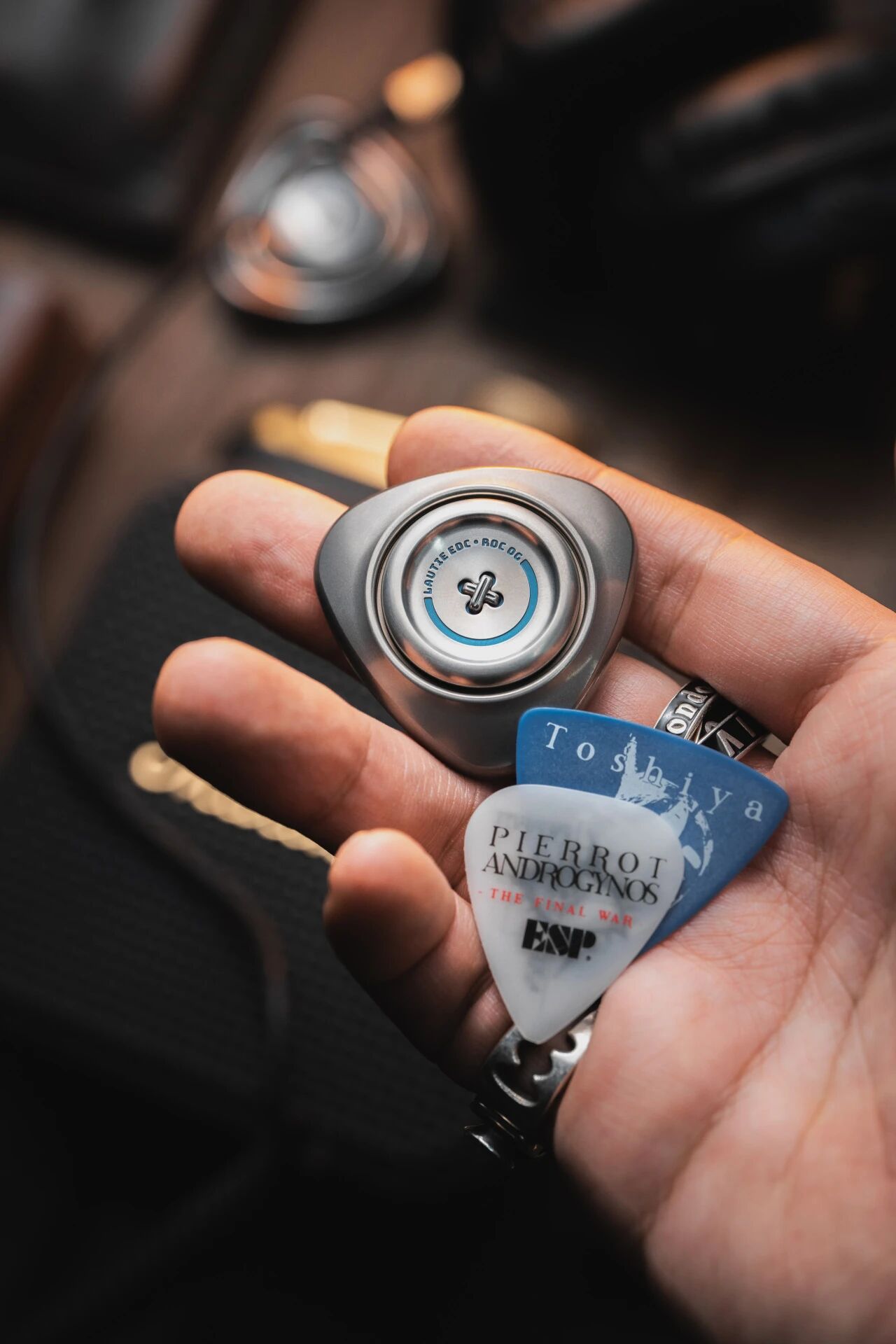
What that removes: the stack error that lives in a threaded fastener system. When there’s no fastener introducing its own tolerance band, the only variable left is the machined surface-to-surface fit — and that’s something you can hold to extremely tight tolerances. The result is a bearing seat with less coaxiality error, and a body that runs with tighter lateral stability during spin.
There’s a geometric downstream effect that carries over into the hold: the body goes thinner. With interference fit, you’re not designing wall thickness to accommodate fastener geometry — the halves just close on each other. ROC OG profiles slimmer than the ROC 2.0 reference, and the dual-lock gap narrows to match. Compact in hand. No mechanical slop.
The R188 bearing at the center is a format Western collectors already know — widely available, tunable, compatible with some third-party dual-lock configurations. LAUTIE didn’t reinvent the bearing. What they brought was a seat machined tighter than a screw-assembled body makes practical, and a profile that reflects that constraint. Press-fit is an engineering spec you’d normally find in precision mechanical assemblies. ROC OG carries it into a daily fidget piece — and that’s the structural move that opens a new path inside the 2099 lineup.
Old details, new geometry
The interference fit is the engineering foundation. The design is where LAUTIE made a different kind of argument.
ROC OG keeps the classic tri-arm silhouette — three rotating arms with geometry the scene has refined across generations — but the arc on those arms has been adjusted. Fuller. More rounded than its predecessors in the ROC line. That reads like a footnote until you hold the piece: when your fingertip settles on the blade edge, the curve meets you instead of making you search for the spin angle. The contour does the positioning work so you don’t have to think about it. That’s not just aesthetics — that’s geometry earning its keep.
Paired with the revised arc are two design details that do visible work on the blade face. The first is the button lock — a circular interlocking detent compatible with standard R188 dual-lock accessories — which breaks the flat arm plane with a round inset profile. It’s a functional element that happens to read cleanly, the way a well-set rivet reads on a piece of hardware. Around the lock edge, OG stitching runs tight: hand-finished detail lines, visible plain-sight, no magnifying glass required. The stitching creates a visual border between the button lock and the blade surface, giving the arm face depth without adding material complexity.
The third element is the Magnetic Decorative Plate — a swappable face panel held flush by a magnetic mount. The plate carries a liquid-metal surface finish: tilt the piece, watch the reflection path shift. Against a polished stainless or zirconium alloy body — available in Silver or Gold — that finish registers as a color-contrast pop — not a flex for its own sake, but a tool for pushing light-dark separation along the tri-arm outline edges, making the silhouette read sharper in hand.
None of these — the arc geometry, the button lock position, the decorative plate placement — are arbitrary. Each one maps to a natural finger contact point during carry or play. In most spinners, aesthetic decisions happen after the engineering is locked, getting pasted on top. Here they happened simultaneously — aesthetic logic and ergonomic logic landing at the same coordinates rather than competing — and that kind of alignment is rarer than it should be across the fidget spinner collector space.
The feel: smooth, quiet, and surprisingly open
Set it on the desk. Flick it. It spins — no grip angle required, no warm-up, no studied technique. The ROC OG just goes.
That ease is the point. The rotation is genuinely smooth, and the sound lands somewhere between a quiet hum and a drawn-out sigh — like a fine thread going taut then releasing, with a little resonance trailing behind in your fingertips. It’s not the kind of feedback that performs. You’re not doing this to show anyone. It’s what you reach for when a meeting stalls or a sentence won’t form — a few rotations, the mental static clears, and you come back. LAUTIE describes it as chocolate-smooth, which is maybe overstating it, or maybe exactly right.
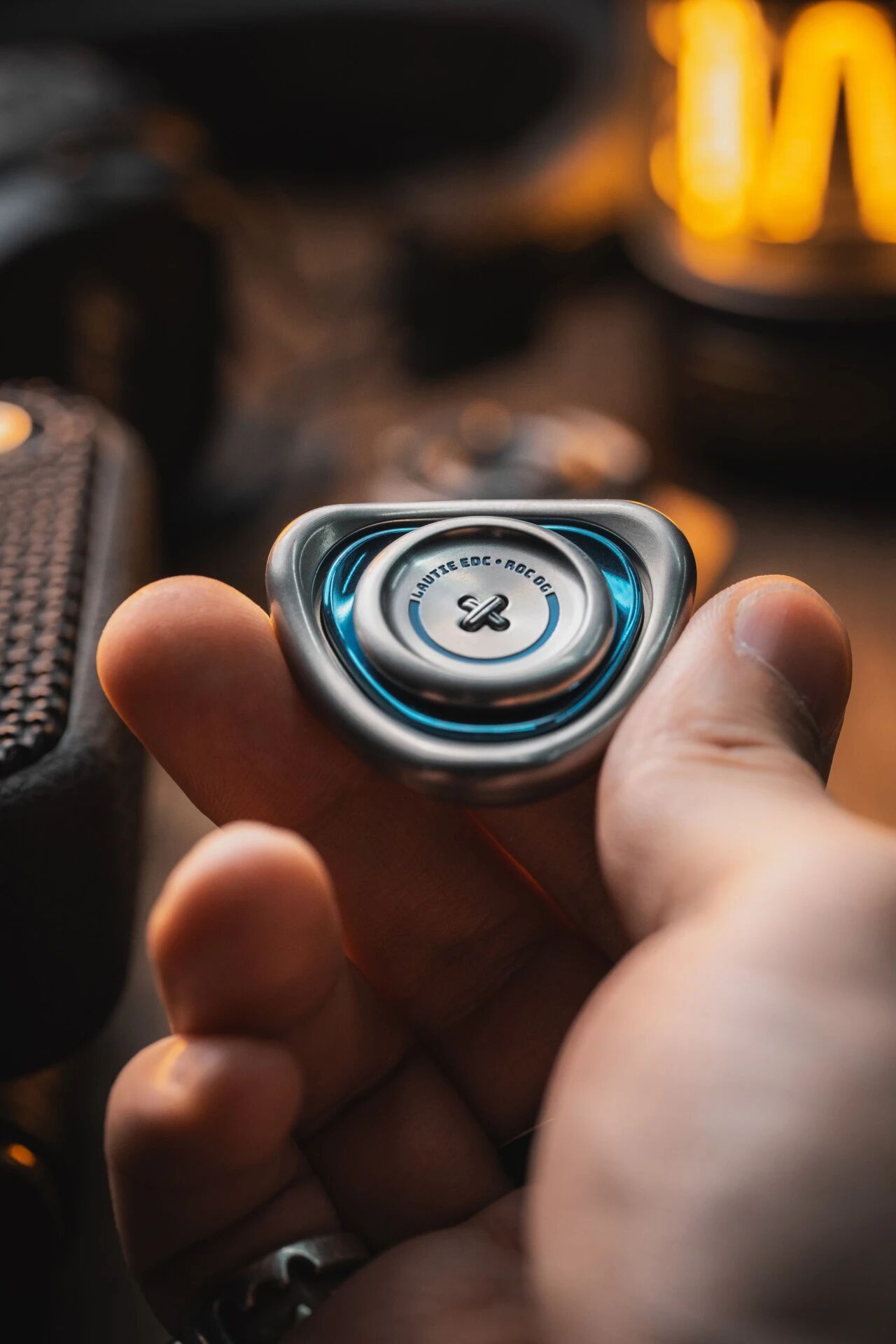
The interference fit that shaped the ROC OG’s proportions carries a practical side effect: the tighter body geometry creates compatibility with certain third-party R188 Buttons — the small weighted rings collectors swap onto a spinner to tune spin duration and feel. Not all third-party options will seat correctly; fit depends on manufacturing tolerances and varies by source. But for collectors who like to experiment, the opening matters. The ROC OG ships with a stock R188 configuration that’s already balanced and smooth — that’s a deliberate starting point, not a floor. Swap in a heavier Button and the spin slows, deepens, centers more mass at the rim. Go lighter and the profile shifts the other way. Neither is right. They’re just spin states you haven’t tried yet.
This is where the ROC OG reads as a platform rather than a single fixed object. The same interference fit that keeps the build rigid enough to feel premium keeps the tolerance window tight enough to accept quality third-party hardware. That alignment of engineering logic and collector logic doesn’t happen by accident.
Out of the box, the ROC OG is already where most collectors in the fidget spinner space land and stay. For the ones who like to tune: the door is open.
Three versions, one Friday
LAUTIE ran the ROC OG as a Friday drop in early March 2026 with a tiered access window — collectors inside the brand’s inner circle got early entry hours before the general queue opened. Not unusual for LAUTIE. What is worth noting: all three variants launched simultaneously, and every one of them runs the same mechanical specification. The entire price difference across this lineup is a material decision, not an engineering upgrade.
That’s the sentence to hold before you read the next paragraph. You’re not getting a better-spinning ROC OG at the upper tier. You’re getting a different one — same R188 bearing, same interference fit, different surface reading in your hand and in a photograph. Three versions of identical function wearing three different coats.
The builds, stacked by material: entry is Stainless Steel paired with Zirconium Alloy in mirror polish — a dense, corrosion-resistant metal used across premium EDC for its polished luster. Durable, classic, no statement needed. Mid-tier steps up to a Titanium Alloy with an anodized blue finish, a heat-treated gradient that reads cold and deliberate in direct light. Top tier is the Panda colorway: Zirconium Alloy in mirror polish, black-and-white contrast, the most visually assertive of the three. If the choice narrows to how something photographs on a desk, Panda is the obvious answer. If it’s carry durability and visual restraint you’re after, entry holds its own.
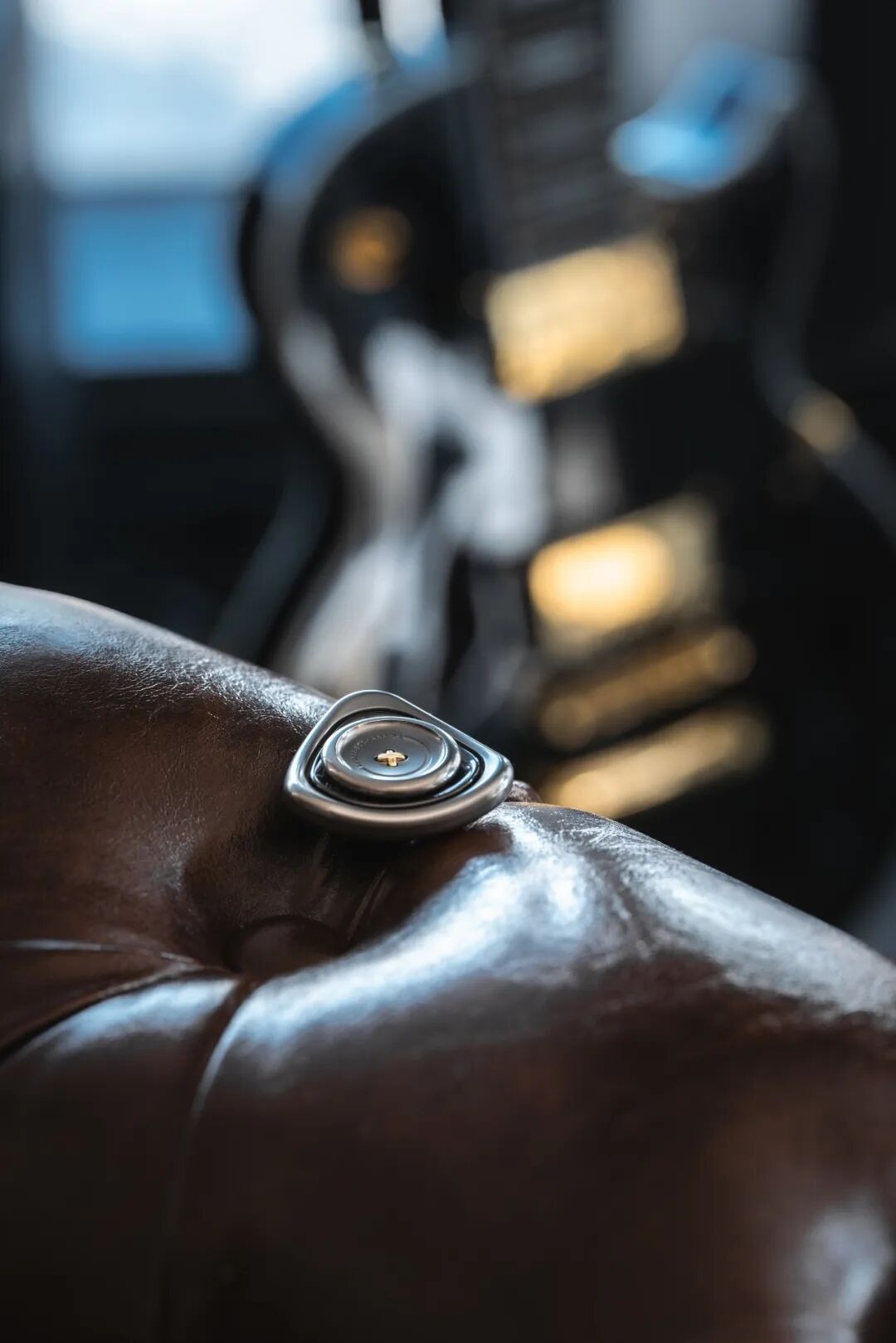
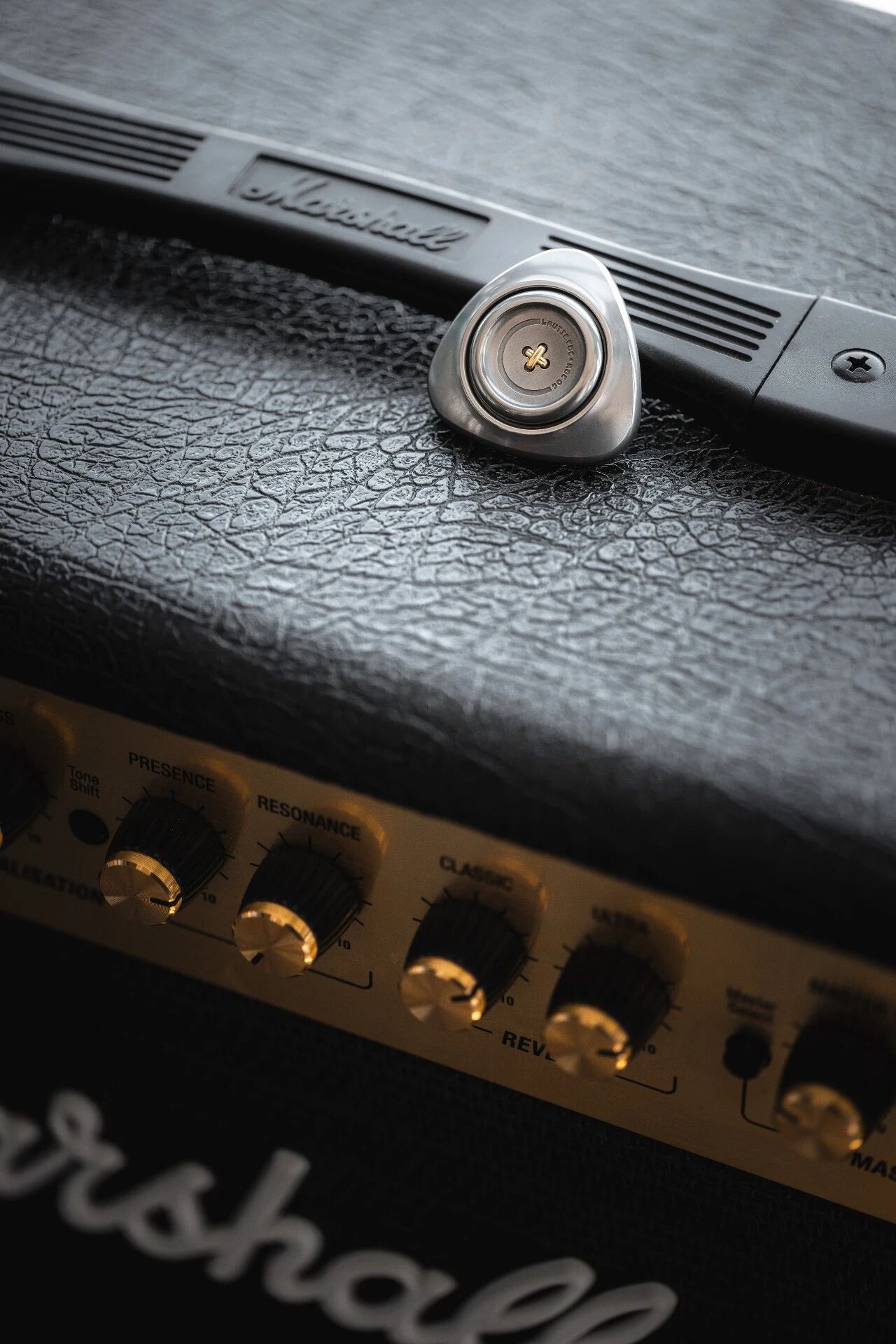
The campaign imagery placed the ROC OG beside a Marshall amp — electric guitar in frame, headphones in reach. No announced collab. No brand partnership. LAUTIE is composing a user portrait instead of narrating one: the person who cares what their tools look like and would leave something worth a second glance on the corner of a rehearsal-room desk. The brand has used scenic framing before to signal their buyer profile. The Marshall staging lands it harder than most. For collectors new to LAUTIE browsing the fidget spinner catalog — that image tells you who this is built for before the product page does.
One brand, two philosophies
The paradox LAUTIE built with ROC OG is almost too clean: their first interference-fit spinner is also their most stripped-back one. For a brand that runs the NOIZ series — a flagship spinner line built around precision mechanics, layered play depth, and design language that genuinely rewards extended study — the ROC OG is the exact opposite call. Same brand, entirely different posture.
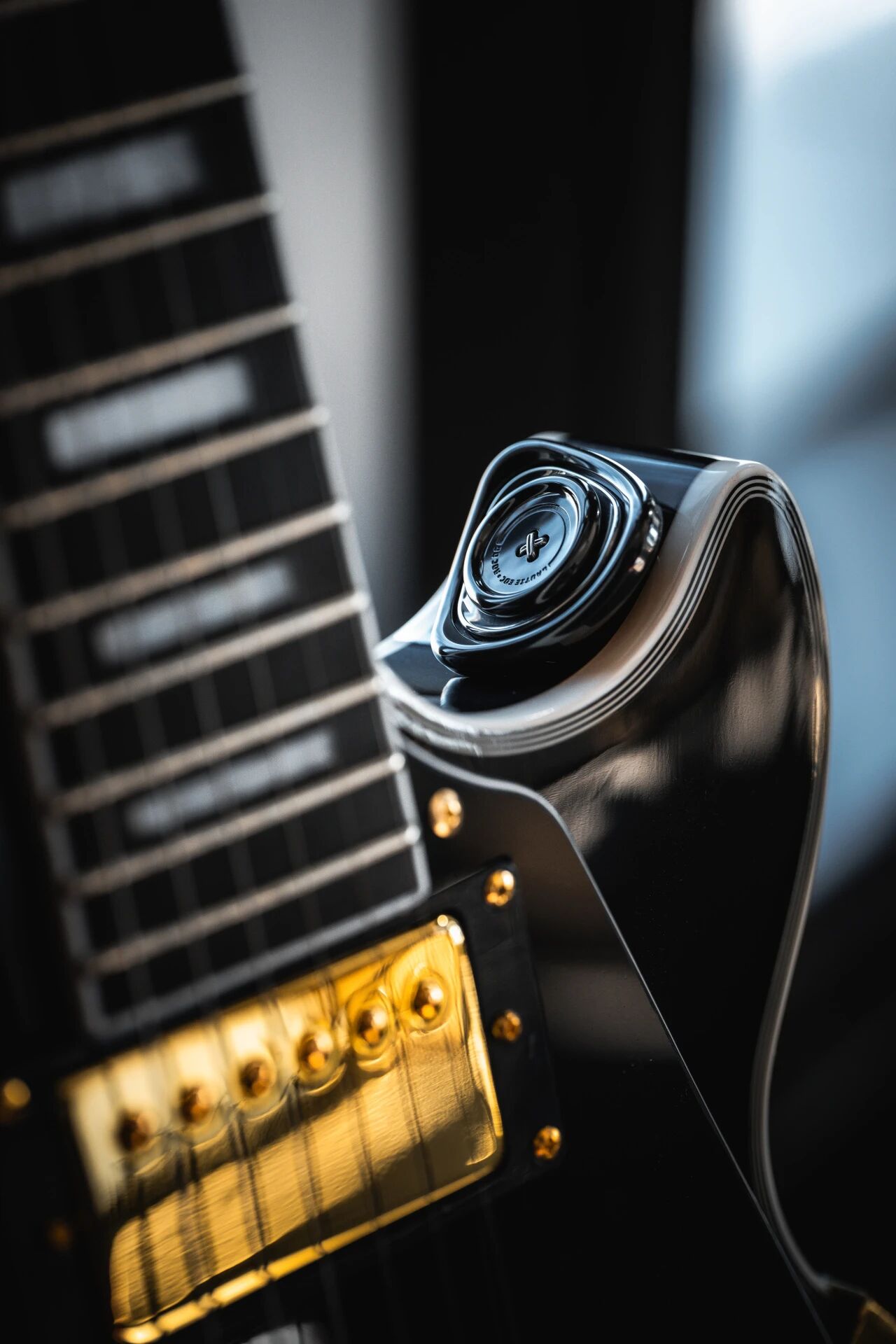
NOIZ is complexity as the feature. ROC OG is restraint as the statement. Neither is wrong for the brand — they’re different dimensions of the same design ethos, not competing lines. NOIZ asks you to learn the piece. ROC OG asks you to trust it. Both are valid entry points into the LAUTIE fidget spinner catalog, depending on where you are in the hobby. Some collectors have both. That’s also a completely valid answer.
LAUTIE’s long-standing slogan is “STAY COOL & BE DIFFERENT.” Six words the brand has operated by for years. ROC OG carries that quietly — no performance, no explanation required. The brand could have loaded their first interference-fit spinner with every trick in the catalog: tiered mechanics, modular add-ons, collector-bait complexity. They didn’t. They gave it an R188 bearing, a tight press-fit, two material options, and got out of the way. That’s a specific kind of confidence — the kind that doesn’t need to explain itself. For Western collectors sourcing pre-owned LAUTIE stock, the ROC OG is the piece that asks the simplest possible question and means it: can a spinner that purely spins still hold its own in a serious collection? LAUTIE’s answer is yes. The ROC OG is the proof.
Insider take: what working resellers actually see
We carry this every drop. Here’s what the spec sheets miss: the CHOC configurations most collectors talk about and the configurations that actually move are not the same list — and the gap between them is wider than you’d expect.
Mokuti and Zircuti dominate the inquiry queue. We’ve tracked them pulling roughly forty percent of all LAUTIE questions we receive, despite representing well under twenty percent of the total catalog. The community treats these finishes as the definitive LAUTIE experience, and the review ecosystem amplifies that signal. Every showcase, every forum thread, every teardown leads with the exotic metals. The impression you get from coverage is that LAUTIE is an exotic-material brand with a long tail of practical configs.
But watch the pre-owned shelf instead of the forum. Corian and PC Mechanic I configurations clear our pre-owned inventory in under three weeks each restock cycle. PEEK-rail variants sit two to three times longer — same brand, same price tier, same drop window. The exotic-material pieces generate the noise. The carry-friendly material combinations generate the transactions. Pre-owned Mokuti and Zircuti pieces do command a 30-50% premium when they surface, but they surface less frequently — partly because buyers who acquire them are holding, not flipping.
Here’s what that split reveals: LAUTIE’s loudest buyers and LAUTIE’s most active buyers are two different populations. The inquiry volume concentrates in Mokuti and Zircuti because those buyers are doing visibility work — posting, discussing, comparing. The Corian and PC Mechanic I buyers are quieter. They arrive with intent. The inquiry-to-purchase ratio in our queue runs tight, clustering closer to research-complete than browse-mode, which means most people asking about availability have already decided. They’re just timing the window.
One more signal worth noting: the pre-owned inquiry base for LAUTIE skews heavily toward US and EU collectors rather than buyers in the brand’s home market — which runs counter to the assumption that boutique EDC brands primarily trade domestically. LAUTIE has built genuine secondary demand internationally, and that geographic spread is part of why the 48-72 hour sellout windows on new drops convert into sustained pre-owned premiums rather than market saturation.
If you’re evaluating a LAUTIE CHOC purchase based on what gets covered, you’re reading a sample biased toward the collector-display segment. The daily-carry segment is quieter and more decisive. Know which buyer you are before you enter a drop window — it changes which configurations you should be monitoring and what price point to target.
First-party data: the three builds
ROC OG: Stainless Steel + Zirconium Polish. LAUTIE’s first interference-fit spinner runs an R188 bearing inside a press-fit body, holding the spin axis tight without threaded fasteners. The design carries the classic tri-arm geometry forward with retro accents, color-pop highlights, OG stitching detail, and a magnetic swappable plate with liquid-metal finish. Compatible with select third-party R188 dual-lock accessories. This entry-tier build pairs polished stainless steel with zirconium alloy in silver and gold. Effortless flick-and-spin response, refined sound, most balanced build in the lineup.
ROC OG: Panda Zirconium Polish. The Panda colorway runs polished zirconium alloy across the same press-fit R188 platform, finished in high-contrast black-and-white that reads as the most visually assertive of the three. Same retro accent vocabulary, OG stitching detail, magnetic swappable plate with liquid-metal finish, and rounded tri-arm geometry that defines the ROC OG line. Compatible with select third-party R188 dual-lock accessories. Rich visual layering, photograph-first build, the configuration that ends the comparison when collector display drives the pick.
ROC OG: Titanium Blue. The Titanium Blue variant brings heat-treated anodization to the same press-fit R188 platform, the gradient running cold and deliberate in direct light. Same retro accent vocabulary, OG stitching detail, magnetic swappable plate with liquid-metal finish, and rounded tri-arm geometry. Compatible with select third-party R188 dual-lock accessories. Lighter than the steel-and-zirconium build, this is the mid-tier choice for collectors layering color onto the spec without the assertive contrast of the Panda colorway.
 Stainless Steel + Zirconium PolishStainless steel + zirconium alloy, mirror polish; Silver / GoldOpenEntry tier. Effortless flick-and-spin response, refined sound, the most balanced build in the lineup.Mar 2026
Titanium BlueTitanium, heat-treated blue anodization; BlueOpenMid tier. Lighter than the steel-and-zirconium build; color layering without the assertive Panda contrast.Mar 2026
Stainless Steel + Zirconium PolishStainless steel + zirconium alloy, mirror polish; Silver / GoldOpenEntry tier. Effortless flick-and-spin response, refined sound, the most balanced build in the lineup.Mar 2026
Titanium BlueTitanium, heat-treated blue anodization; BlueOpenMid tier. Lighter than the steel-and-zirconium build; color layering without the assertive Panda contrast.Mar 2026
 Panda Zirconium PolishZirconium alloy, polish, panda colorway; Black / SilverOpenTop tier. High-contrast black-and-white, the most visually assertive; the photograph-first build.Mar 2026
All three builds run the same mechanical specification: interference-fit body, R188 bearing, button interference locks, magnetic decorative plate. None is limited; all released as a scheduled drop in early March 2026.
Featured ROC OG in stock
Pre-owned · Entry tier
ROC OG Stainless Steel Zirconium
Check price
 Pre-owned · Mid tier
ROC OG Zirconium
Check price
Pre-owned · Panda colorway
ROC OG Zirconium
Check price
Pre-owned · Mid tier
ROC OG Zirconium
Check price
Pre-owned · Panda colorway
ROC OG Zirconium
Check price
FAQ
Q01How does interference fit change the bearing maintenance loop — can I still swap bearings?
Yes, but it’s not a casual Tuesday swap. The two body halves are press-fit together, which means separating them takes a press tool or a careful dead-blow tap — not a screwdriver. If you’re someone who tunes bearings weekly, build that expectation in. If you’re set-and-go with one well-tuned R188, the press-fit adds zero friction to your carry routine.
Q02Is the R188 format compatible with accessories I already run on other 2099 pieces?
Generally yes. R188 is the hobby standard — widely shared across LAUTIE’s lineup and most other spinners in this weight class. ROC OG’s interference-fit construction changes how the body halves lock, not the bearing cavity dimensions, so R188-compatible caps and third-party inserts should seat without issue.
Q03Does the shortened lock gap actually matter for fingertip hold vs. a pinch grip?
Concretely. A tighter gap means less air between your fingertip and the mass — the piece tracks closer to the hand axis during spin, which reads as tighter, more controlled rotation. Wide-body spinners have a looser, more theatrical feel. ROC OG’s geometry compresses that sensation into something more deliberately compact.
Q04What’s the “OG” actually referencing — throwback branding or something more specific?
Both. OG in collector shorthand means “original” or “originator” — the piece that started something. LAUTIE is using it to mark this as their first interference-fit spinner. The design language — button interference locks, OG stitching detail, magnetic accent plates — signals a classic-format ethos rather than complexity for its own sake.
Q05Should I prioritize ROC OG or ROC 2.0 if I’m choosing one LAUTIE spinner to start with?
Depends on what you want out of a spinner. ROC 2.0 (52.4 g, 40.3 mm wide) is the benchmark mid-size — heavier, more classic throw weight, screw-assembled body. ROC OG is the tighter, press-fit answer with a slimmer profile and a harder engineering argument underneath it. First spinner ever: ROC 2.0. Already own one and want a different take on the same format: ROC OG.
Q06Can the magnetic accent plates be swapped without tools?
That’s the point. Magnetic mounting means they pull off and reset without a screwdriver in the picture — the whole design choice is that you can change the visual language of the piece in ten seconds. The accent plate system is the one modular dimension LAUTIE allowed into what is otherwise a fixed, press-together assembly.
The bottom line
Three versions, three collector profiles — and the ROC OG is unusually honest about which one you are. The stainless steel with zirconium outer ring is the most balanced entry: heaviest feel, most stable spin, the version that holds its own against everything in the LAUTIE lineup without needing a story behind it. If weight isn’t your anchor and you want color layering over raw mass, the anodized titanium variant gets lighter without getting cheap. And if you collect for narrative as much as feel — the Panda colorway zirconium is the piece that ends the comparison. That’s the version you stop photographing and start carrying.
The interference-fit assembly isn’t something LAUTIE invented for ROC OG. ROC 2.0 already ran the whole logic at scale — precision bearing seat, button interference locks, the works — and it held. ROC OG wears different skin on the same proven skeleton. If you trusted the 2.0, you already know what you’re getting here.
Every LAUTIE collector has their own version of the brand: the steel loyalists who never swap and never sell, and the colorway chasers who hit every new drop. The ROC OG accommodates both. That’s the point. LAUTIE doesn’t ask you to pick a side — it just keeps building pieces that both camps end up fighting over.
First time considering a LAUTIE interference-fit spinner? Do a pre-owned price pass before committing. The secondary market for ROC variants has legitimate depth, and knowing the spread before you buy is homework that pays off.
Browse the LAUTIE catalog for current and pre-owned ROC variants across the full lineup, dig into the fidget spinner section for interference-fit and precision-spin pieces from the broader boutique segment, or go straight to pre-owned if you want authenticated collector-grade stock without the drop-day scramble.
The LAUTIE ROC OG variants covered in this article are now live in our pre-owned catalog as authenticated collector-grade pieces. Three single-unit listings across Stainless Steel + Zirconium and Zirconium colorway configurations, priced from 215 to 396 USD. First-come basis since each variant carries one-of-one inventory.
View available ROC OGTRB Creation is a preowned EDC fidget toy specialist focused on discontinued and rare designer pieces from LAUTIE, ACEdc, 01EDC, JUZHEDC, MOT, GD EDC, and other independent workshops. This guide draws on direct preowned inventory handling, continuous secondary market tracking, and specifications sourced from LAUTIE’s official release materials.
Last updated: July 18, 2026. Mechanism descriptions follow LAUTIE’s own release language; where the record lacks a figure, this guide says N/D rather than guessing.
