

Aluminium alloysColour, mixed parts and white oxide surfaces
Start with the part made from aluminium, then look at its finish and the complete configuration.
Jilian brings colour to two-arm and three-arm spinners. Fushe combines an aluminium body with steel plates, while Breaker Howitzer gives its aluminium body a white ceramic surface. Their material names belong to specific parts, grades and finishes.
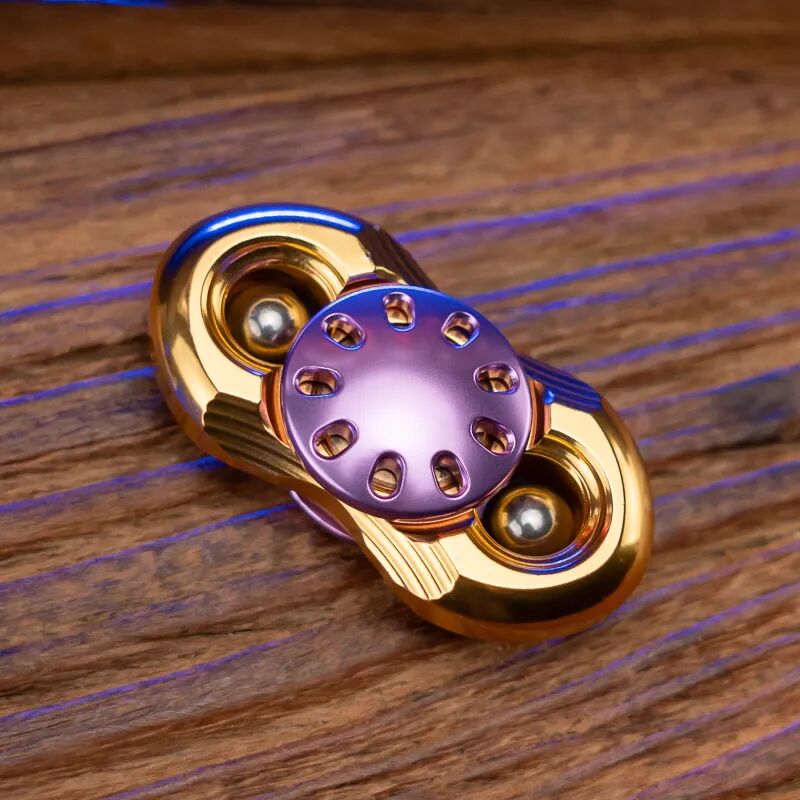
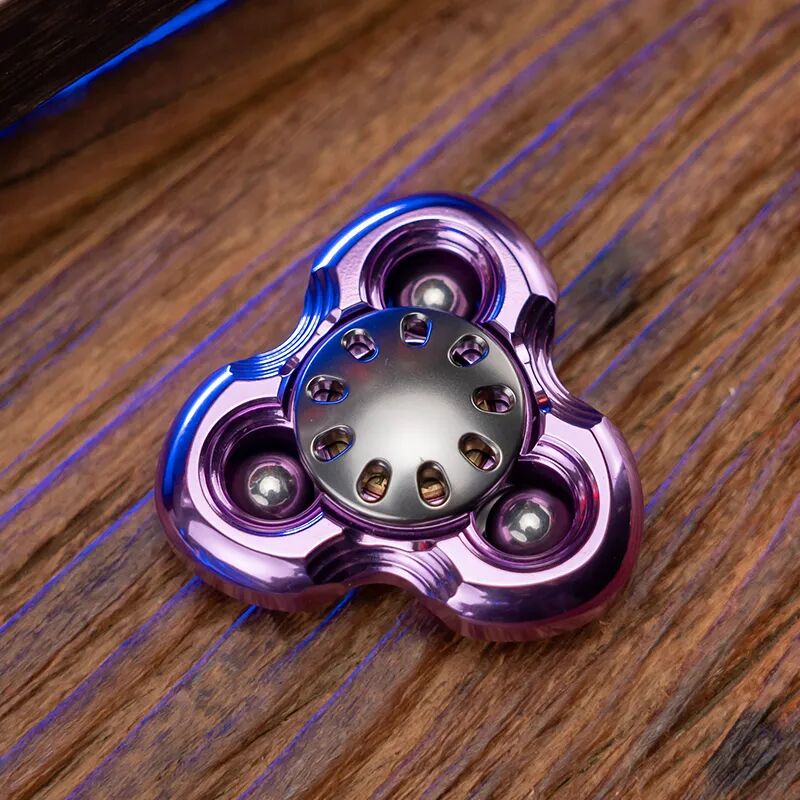
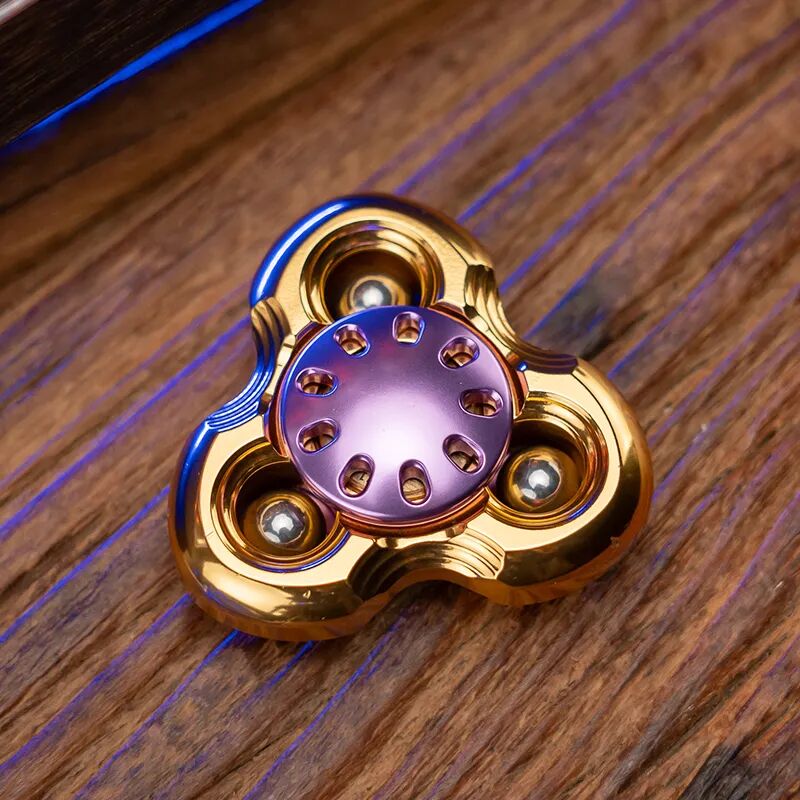
The gold three-arm configuration. Its aluminium-alloy finish combines anodic colouring with the maker-described pearlescent stonewash; the original balls are stainless steel.
Jilian: colour follows the shape
The purple two-arm Jilian. Curved surfaces, an openwork button and ball grooves create distinct areas of reflection.
Two-arm and three-arm forms share a colour palette
Liangzai EDC offers Jilian in stainless steel and aluminium alloy. The aluminium version combines anodic colouring with a finish the maker calls pearlescent stonewash. Gunmetal, gold and purple are paired across the body and button.
Both two-arm and three-arm versions retain the outer ball grooves. The release specifies 8 mm balls, with stainless-steel balls fitted as standard, so even the coloured aluminium version is a mixed-material assembly. The photographs reveal the outline, cut-outs and highlights; how it spins still depends on its configuration.
Fushe: an aluminium body with steel plates
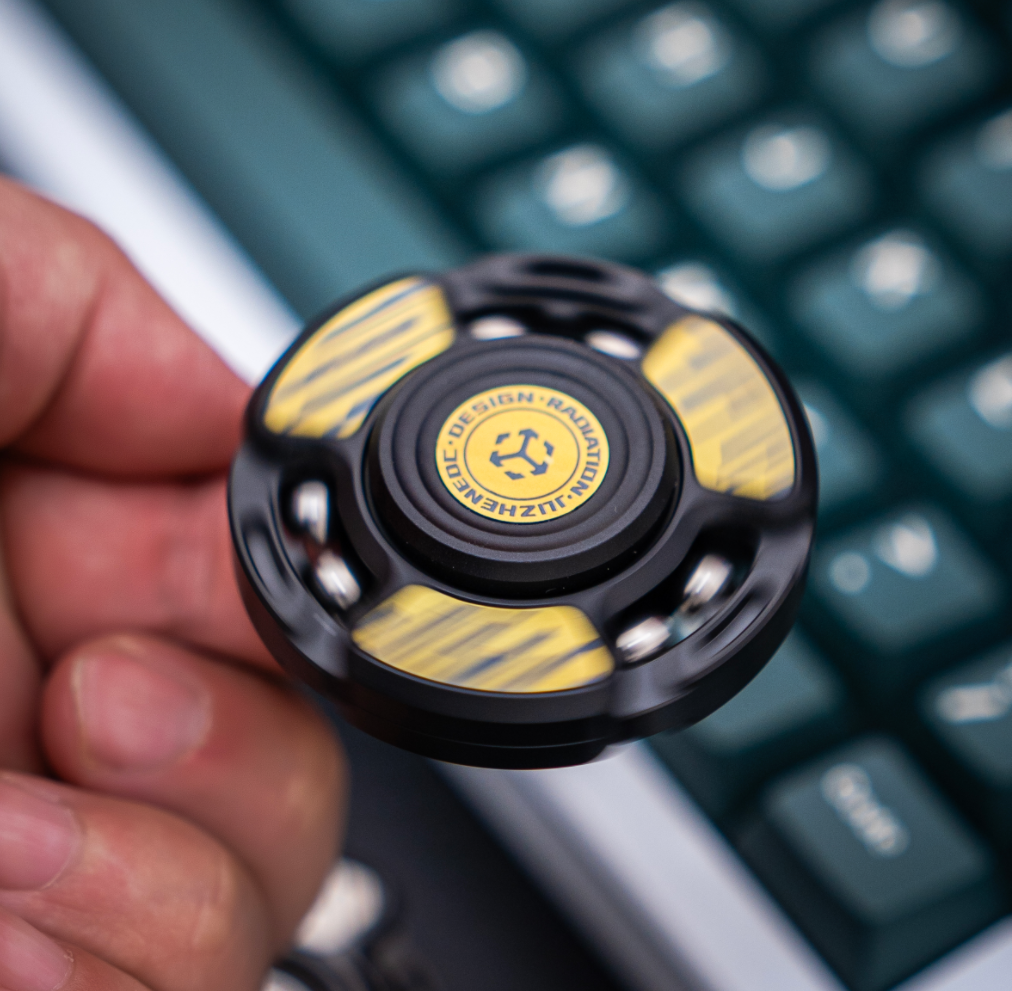
The initial Fushe release from Juzhen EDC includes a black aluminium-alloy version. Its moving plates are stainless steel across all body-material options. U-shaped plates form extending ball grooves, concealing the balls when retracted and exposing more of the balls and plates when opened.
The body and moving parts are selected separately. The original balls are 6 mm steel, and the maker says that changing their weight changes how the plates open. Body, plates and balls are the useful material distinctions here; the complete spinner is not all aluminium.
A later update removed the decorative inserts and changed to a body machined in one piece. The initial-release photograph here retains the decoration and is kept separate from that later structural description.
The black aluminium-alloy Fushe from the initial release. Its moving plates are stainless steel; the decoration is not treated as a separate material example.
Breaker Howitzer: aluminium beneath the white surface
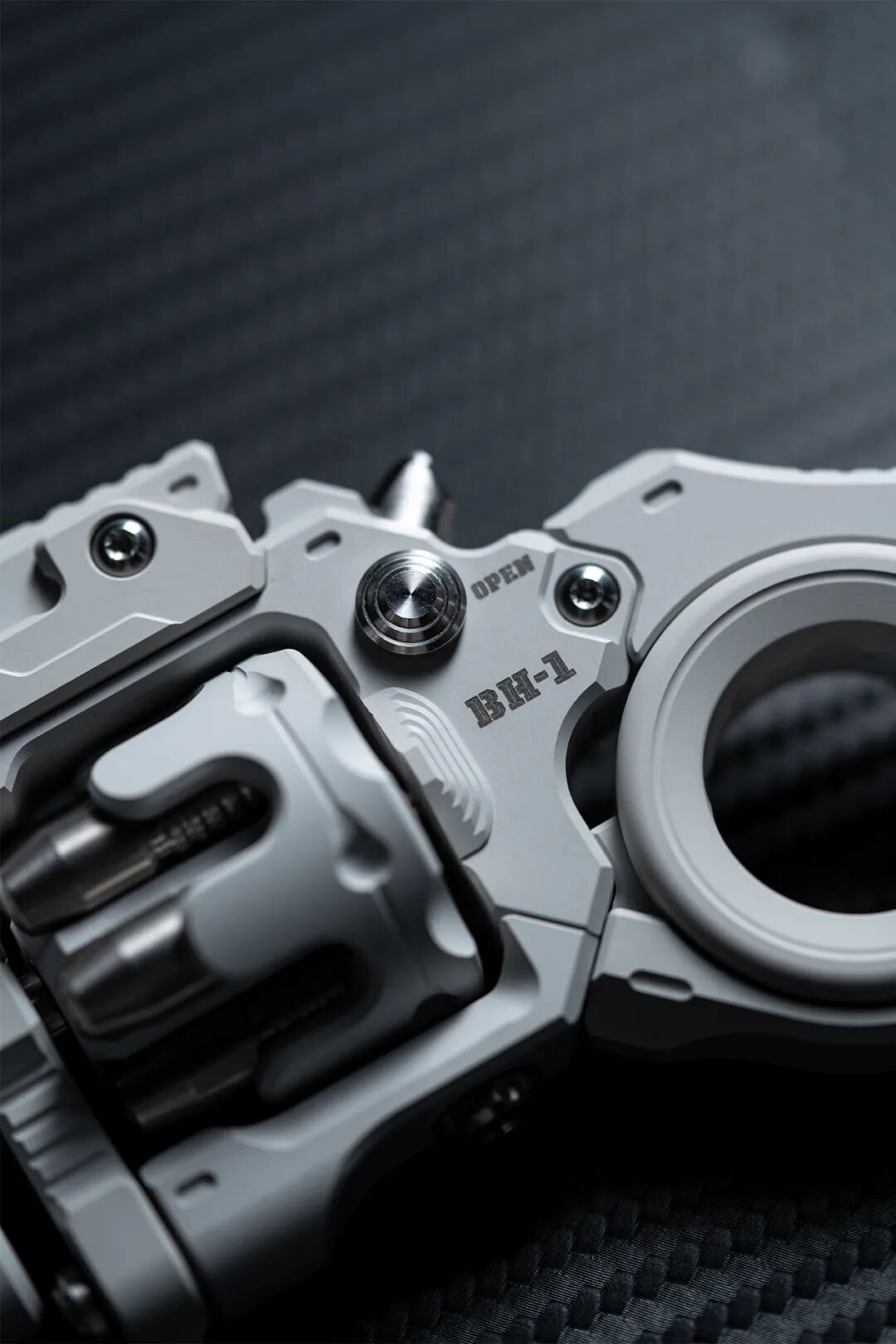
The white aluminium-alloy Breaker Howitzer. The release lists micro-arc oxidation as its surface process and aluminium alloy as its body material.
A ceramic surface on a metal body
EDCELL describes its aluminium-alloy Breaker Howitzer as a mechanical fidget model. Its specification lists an aluminium-alloy body and a white ceramic finish made by micro-arc oxidation. Stainless steel and brass are listed separately for the grenade-shaped parts and internals.
The University of Cambridge identifies micro-arc oxidation as another name for the PEO process, which forms an oxide layer on a metal surface. Coating properties depend on the substrate alloy, electrolyte and electrical parameters. The white appearance here belongs to the surface system of an aluminium body; it does not make the body a solid ceramic part.
Read weight together with the configuration
The 194 g figure in the Breaker Howitzer release applies with the Jiaomie expansion kit fitted. It is neither the weight of a bare aluminium shell nor a general benchmark for aluminium EDC.
GD EDC uses a different combination in Lunhui 2.0: an aviation-aluminium body with a matte black film finish and a finely brushed brass middle layer, with a stated total weight of 38 g. These two products differ in structure, size and parts. Their numbers describe their own configurations, rather than a test comparing materials.
The 58.5 g and 70 g figures in the Jilian article belong to the stainless-steel two-arm and three-arm versions, including steel balls. They cannot be transferred to the aluminium versions.
Look beyond the words aviation aluminium
BPMODS explicitly identifies 7075 aviation aluminium for its Price Tag body, along with hard anodising, blasting and colouring. Lunhui 2.0 is described only as aviation aluminium, while Jilian and Fushe are described as aluminium alloy. These names cannot automatically be expanded into the same grade.
The Constellium 7075 data sheet identifies the aluminium alloy and gives properties for different tempers and product dimensions. Knowing the grade does not establish the temper of a finished EDC part. Grade, temper and surface treatment need to be recorded separately.
Tracks and springs also shape the result
The aluminium Price Tag development article distinguishes two track treatments. The working ball-track area of the stepped version was masked to keep it free from blasting, while the dense-detent version required blasting. Even with the same 7075 body material, the working surfaces were not treated identically.
In a later patch-kit notice, BPMODS traced reported changes in sound during use to purchased springs that differed from the approved samples. This was a particular product and batch issue, and a reminder that sound and detent response are not permanent characteristics of a metal alone.
Aluminium can also carry the collection
SEKI took inspiration from an old metal lunchbox for its aluminium-alloy packaging, using a sliding latch and adjustable cushioning strips inside. The box can be reused to store EDC, lanyard pendants or beads. Aluminium serves as packaging and storage in this example.
Across spinner bodies, slider bodies and storage boxes, identifying the part and its purpose gives the material name context. Grade, finish and the complete assembly then make the comparison useful.
IN THESE FAMILIES
Swipe to exploreThree photographed product lines show colour choices, moving parts and a ceramic surface on metal.
PIECES IN ALUMINIUM ALLOYS
Specific configurations differ in shape, colour and assembly.
ALL MATERIALS
Keep exploring the TRB material guides.
 Aluminium alloysYou are hereVIEW →Materials indexAlloys, polymers and finishesVIEW →
 ZircutiZircuti material guideVIEW →
 SuperconductorSuperconductor material guideVIEW →
Material background
Constellium: 7075 material data sheet · Background on alloy grade, temper and product dimensions; not evidence of the supplier or temper of these EDC parts.
University of Cambridge: Plasma Electrolytic Oxidation · Explains micro-arc oxidation and the oxide layer on a metal surface. Research-sample properties are not assigned to the finished toys.
