

ZircutiRead the pattern, finish and part together
Zircuti can shape a three-arm spinner or appear only in a pair of slider plates.
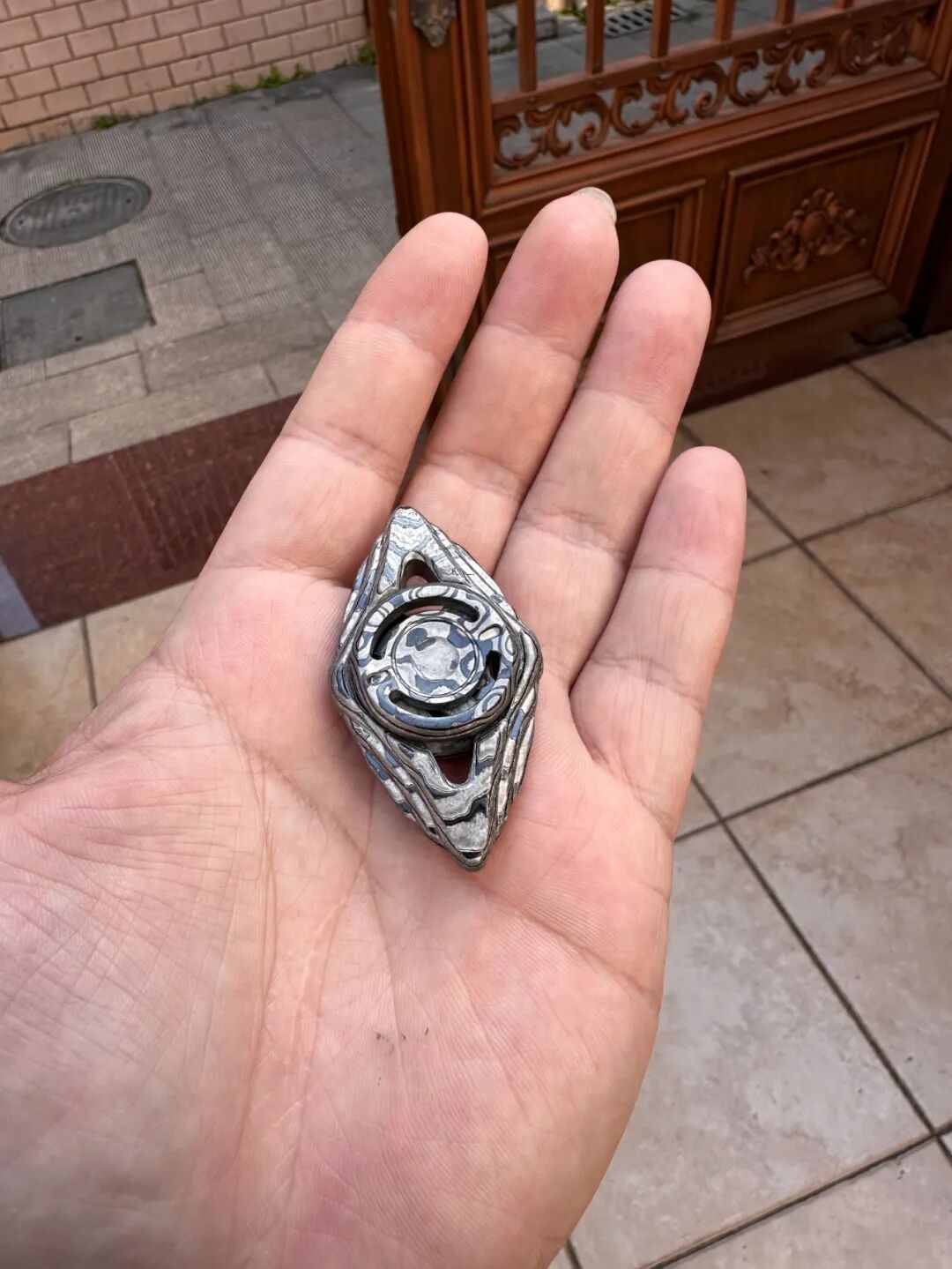
On these EDC pieces, the pattern follows the shape: into the corners of a three-arm spinner, around its central button, or across a small replaceable plate. Candy colours, black and white, and vivid blue-purple finishes give the same design different appearances.
Start with the part that actually uses Zircuti, then look at how the maker names its pattern and finish. A material supplier's product name and an EDC maker's description of a finished piece provide different levels of detail.
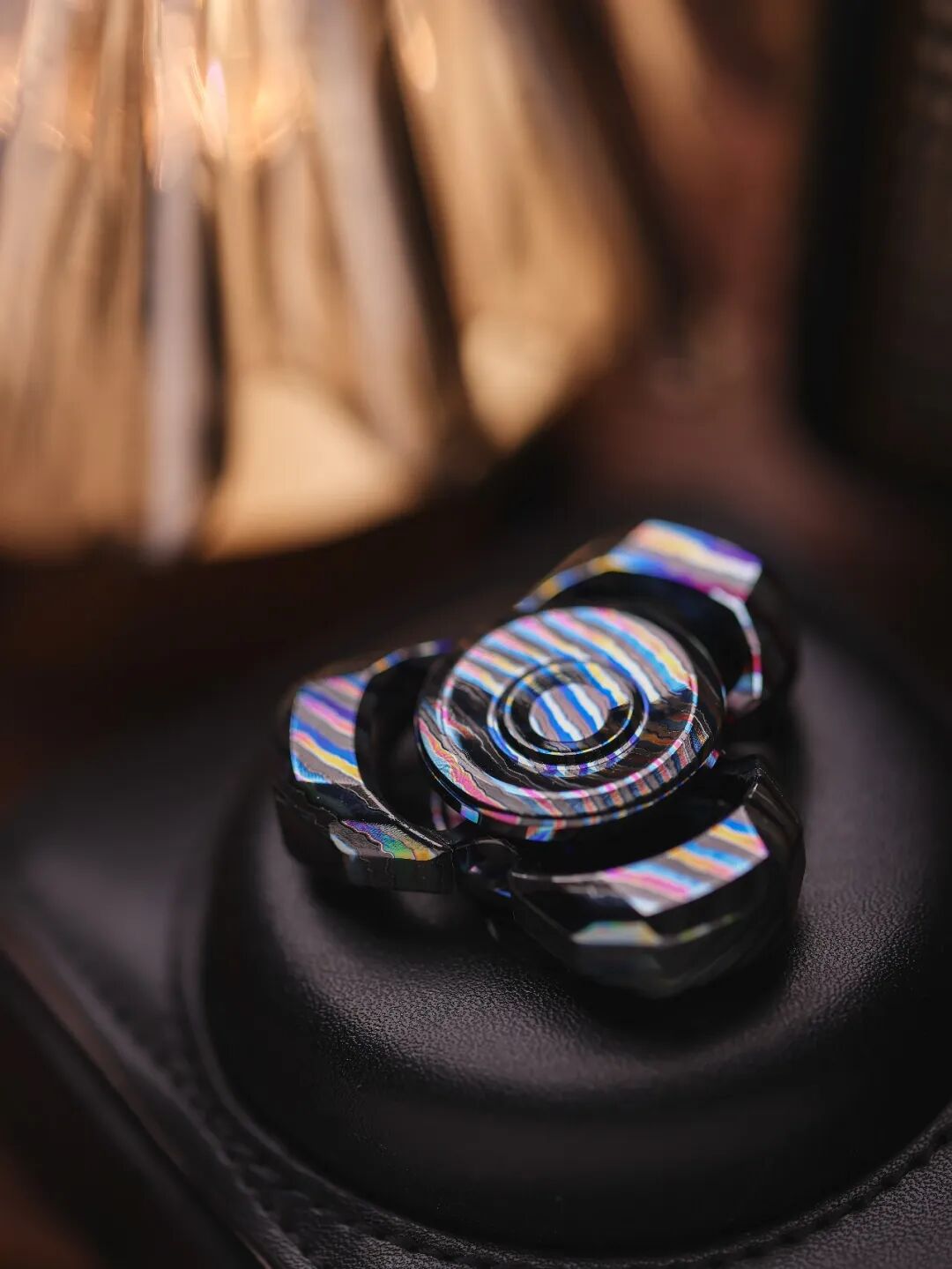
Dreamy Geometry Labs' four-colour Zircuti Whisper-TRI: bands extend across the three-arm shape and the central button.
Three arms give the twisted pattern new directions
The four-colour Zircuti Whisper-TRI. The maker lists this version at about 38 g (±3 g).
Three arms give the twisted pattern new directions
Dreamy Geometry Labs explicitly pairs the Chinese name with Zircuti in its Whisper-TRI release. It describes a four-colour twisted pattern formed through repeated layered forging. In the photographs, fine bands extend across the three arms and the central button; the geometric outline turns the pattern across differently angled faces.
The maker describes fine polishing followed mainly by high-temperature heat colouring, with a small number of low-temperature heat-coloured and acid-treated options. It does not assign exact treatment conditions to each photograph. The Zircuti version is listed at about 38 g (±3 g); the separate Mokume version in the same release is about 61 g (±3 g).
Twisted and ink-wash patterns on replaceable plates
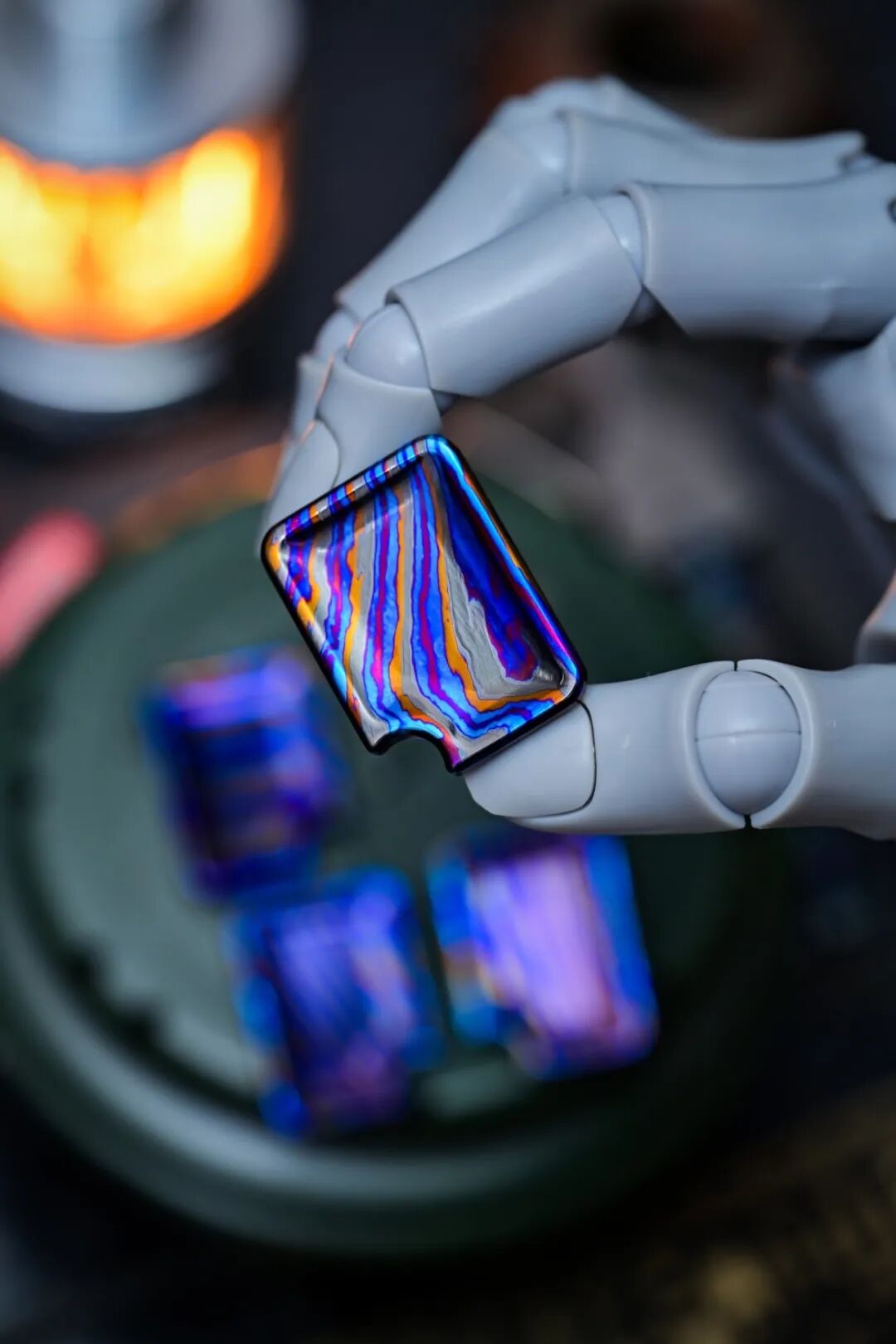
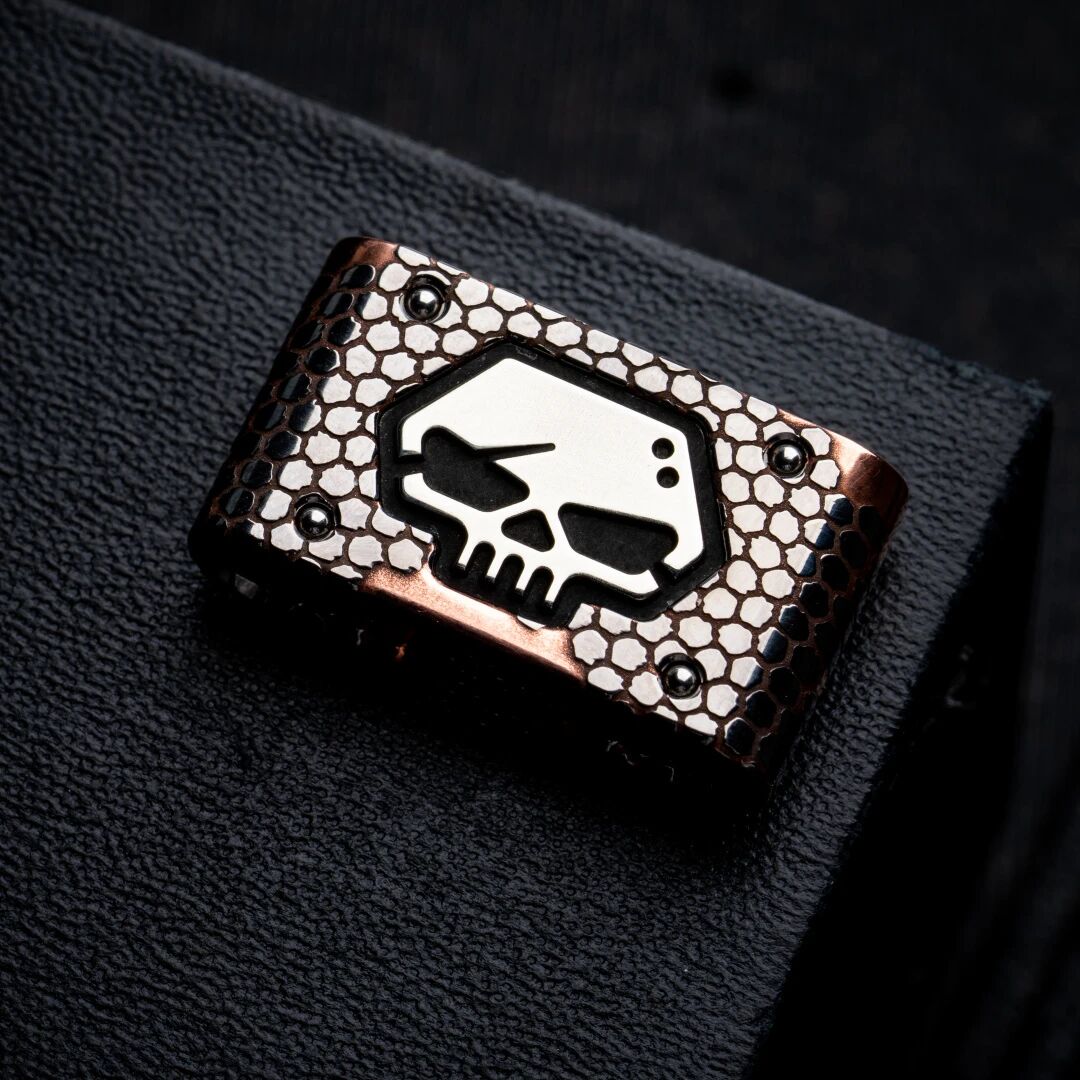
BPMODS twisted-pattern Zircuti plate, with a recessed centre and bands across its face.
Twisted and ink-wash patterns on replaceable plates
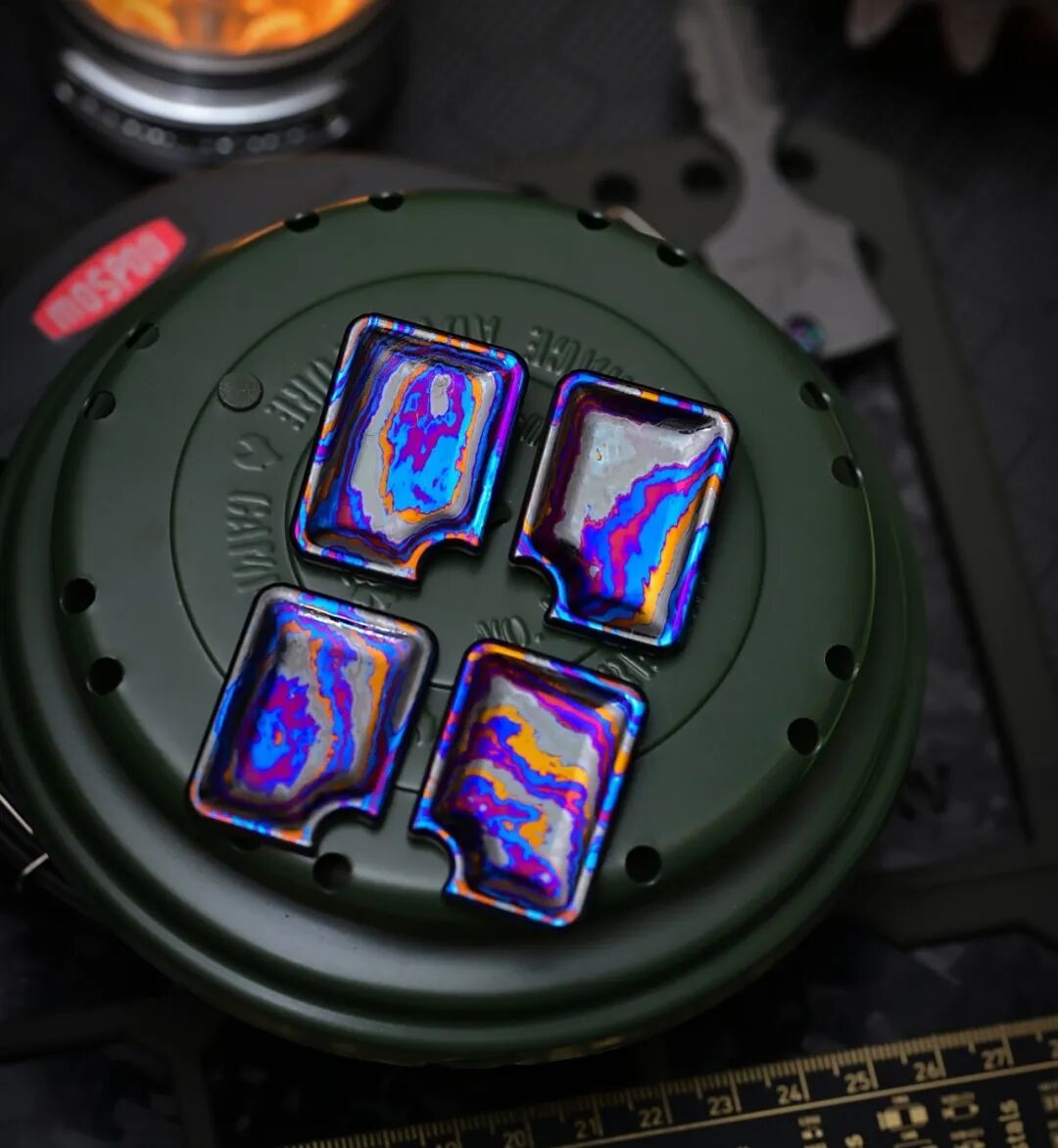
BPMODS introduces Zircuti as replaceable plates explicitly compatible with both Jiugong and Price Tag sliders. Each plate has a recessed centre. Its pattern runs across the face, while highlights along the edges reveal the three-dimensional profile.
The batch distinguishes twisted and ink-wash appearances, describing the latter as a more irregular, diffused pattern. The regular plates receive a high polish and low-temperature heat colouring. The maker also notes a few acid-treated candy-colour and black-and-white exceptions within the twisted-pattern batch. Pattern and finish are separate choices; colour alone does not identify the pattern category.
Shared plates, but a body specifically for Price Tag
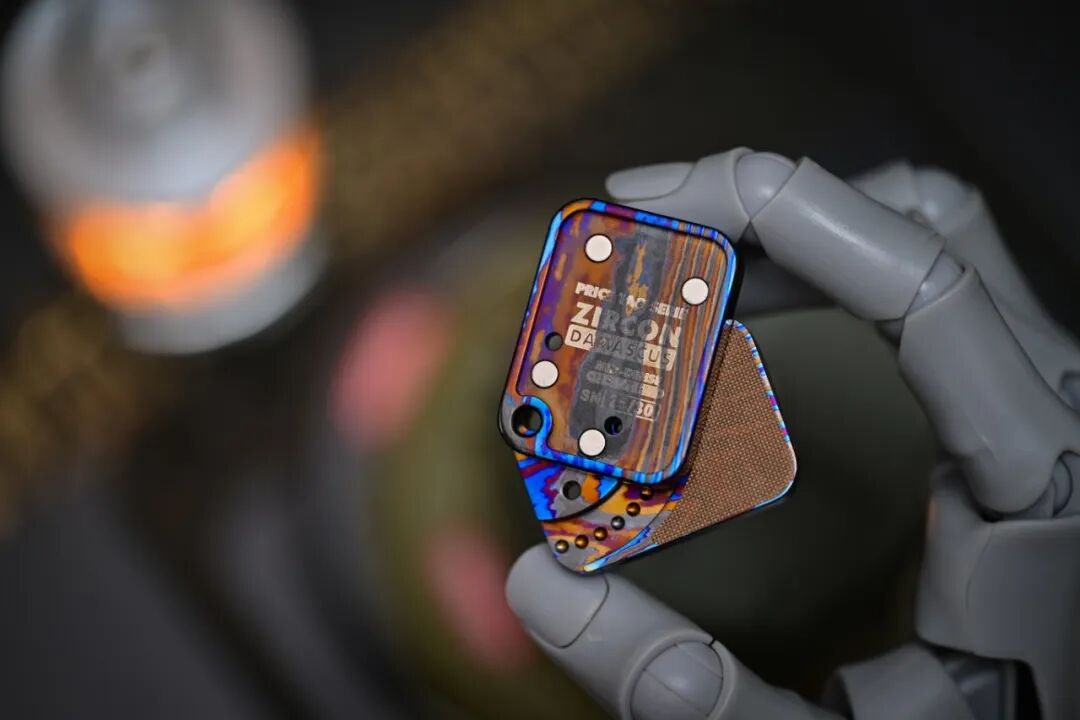
Inside the twisted-pattern Zircuti Price Tag body. This body is specifically for Price Tag; the plates' compatibility with Jiugong does not extend to the body.
Shared plates, but a body specifically for Price Tag
The same release introduces a twisted-pattern Zircuti Price Tag body and explicitly excludes Jiugong. It explains that the required stock thickness differs. Compatibility of the plates therefore does not make the bodies interchangeable.
The inner view reveals magnets, internal features and version markings. The maker specifies a high polish on the body's frame and inner face. This version extends Zircuti beyond a replaceable plate into the body, without implying that every internal component uses the same material.
Candy blue and black and white: colour without a new recipe
The candy-blue Zircuti Shitu from Chuanshanjia EDC. The release identifies each colour beside its photograph.
Candy blue and black and white: colour without a new recipe
Chuanshanjia EDC presents its Zircuti Shitu in candy blue, candy green, candy pink, black and white, multicolour, and coral. The candy-blue photograph shows pale blue and lavender, while the black-and-white version uses light and dark bands to emphasise the same elongated shape.
The release mentions a combination of polishing, acid treatment and anodising, but does not map every colour to a sequence of steps. These are the maker's colour names, not compositions or processing recipes inferred from photographs. The listed weight of around 36 g belongs to this Shitu release, not to Zircuti spinners in general.
A woven-pattern body with a different material for decoration
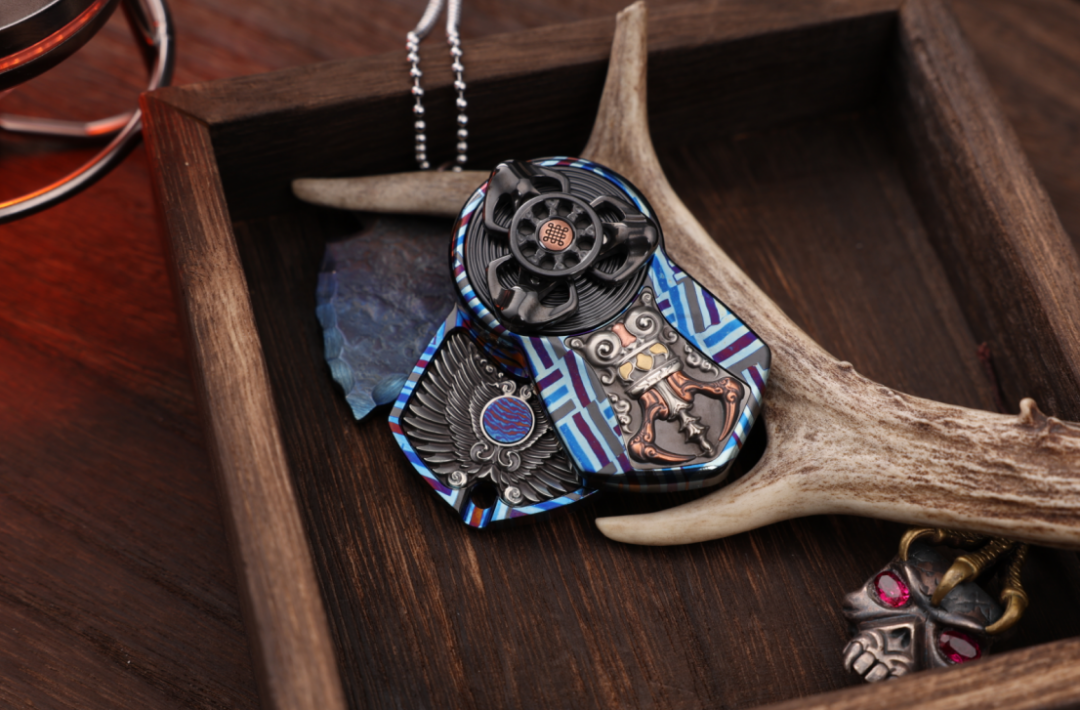
Chima's woven-pattern Zircuti Tuojia: the interlacing body pattern and plates with three-colour copper inlay create distinct visual layers.
A woven-pattern body with a different material for decoration
Chima's woven-pattern Zircuti Tuojia places the interlacing pattern in the body, alongside plates with three-colour copper inlay and a large wing-shaped element. In the front view, coloured bands surround the sculpted plates, giving the body and decoration distinct areas.
Metal Toys Dz makes a similar distinction for its TOP-D Youtiao: the release describes Zircuti with inlaid components called tongma, while the stop plate is a zirconium alloy. On a mixed-material piece, its overall colour does not make the whole assembly one material. The decoration, body and internal stop plate each have their own material description.
A named supplier adds another material clue
Two pieces from the same release. The maker does not identify the specific Nichols billet used for these finished products.
A named supplier adds another material clue
Magic Play titles its Collector Series release Nichols Zircuti and lists Scorpio and Sagittarius three-arm models. Their curved bands fill two different outlines. This is an example of an EDC release that names the material supplier.
Nichols' own Zircu-Ti Boomerang page describes that specific billet as a laminate of 6Al-4V, commercially pure titanium and zirconium. Magic Play's release does not name its billet model. The Boomerang composition therefore cannot be assigned to these finished pieces, or to other products here described simply as Zircuti.
Reading material names in their supplier context
A manufacturer's exact product name carries more detail than a broad material label. Nichols lists 6Al-4V and commercially pure titanium for Moku-Ti Boomerang, while Zircu-Ti Boomerang also lists zirconium. These two products from the same supplier have different stated compositions despite both having coloured, layered patterns.
Names such as tima, Mokuti and Zircuti need to be checked against the wording of each product release. Alpha Knife Supply also uses the Timascus® name and distinguishes several pattern structures. These supplier names are not a universal grade for every finished piece, and black and white, candy colours and heat colouring are not additional materials.
Pattern depth also has conditions. Alpha Knife Supply describes different machining characteristics for its Single Pattern, Double Pattern and Mosaic ranges; its Mosaic description specifically states that the pattern extends through the billet. Without knowing the billet structure of an EDC piece, there is no general promise that its pattern will remain unchanged after deep grinding.
IN THESE FAMILIES
Swipe to exploreFive groups of pieces show Zircuti in complete spinners, replaceable plates and mixed-material bodies.
PIECES IN ZIRCUTI
Compare specific configurations: a small outer plate, a body with internal features, or different colours on the same shape.
ALL MATERIALS
Keep exploring the TRB material guides.
 ZircutiYou are hereVIEW →Materials indexAlloys, polymers and finishesVIEW →
 SuperconductorSuperconductor material guideVIEW →
Material background
Nichols: Zircu-Ti Boomerang · This specific billet lists 6Al-4V, commercially pure titanium and zirconium; it is not a composition for all finished Zircuti products.
Nichols: Moku-Ti Boomerang · This product lists 6Al-4V and commercially pure titanium, illustrating the difference between specific products from one manufacturer.
Alpha Knife Supply: Timascus material information · Describes pattern structures and machining-depth conditions; it does not establish that these EDC products use AKS material.
