

Crystallized TitaniumFrom natural-colour crystal patterns to colour in motion
Crystallized titanium brings a patchwork of visible texture to curved shapes, polished surfaces and coloured finishes. The Xingqiu lanyard bead, Chang Gong spinner and SEKI Bo offer three ways to look at it.
Keep three questions separate: what texture is visible, which surface processes the maker describes, and whether a material grade is specified. These examples retain the process descriptions and sample conditions of each product.
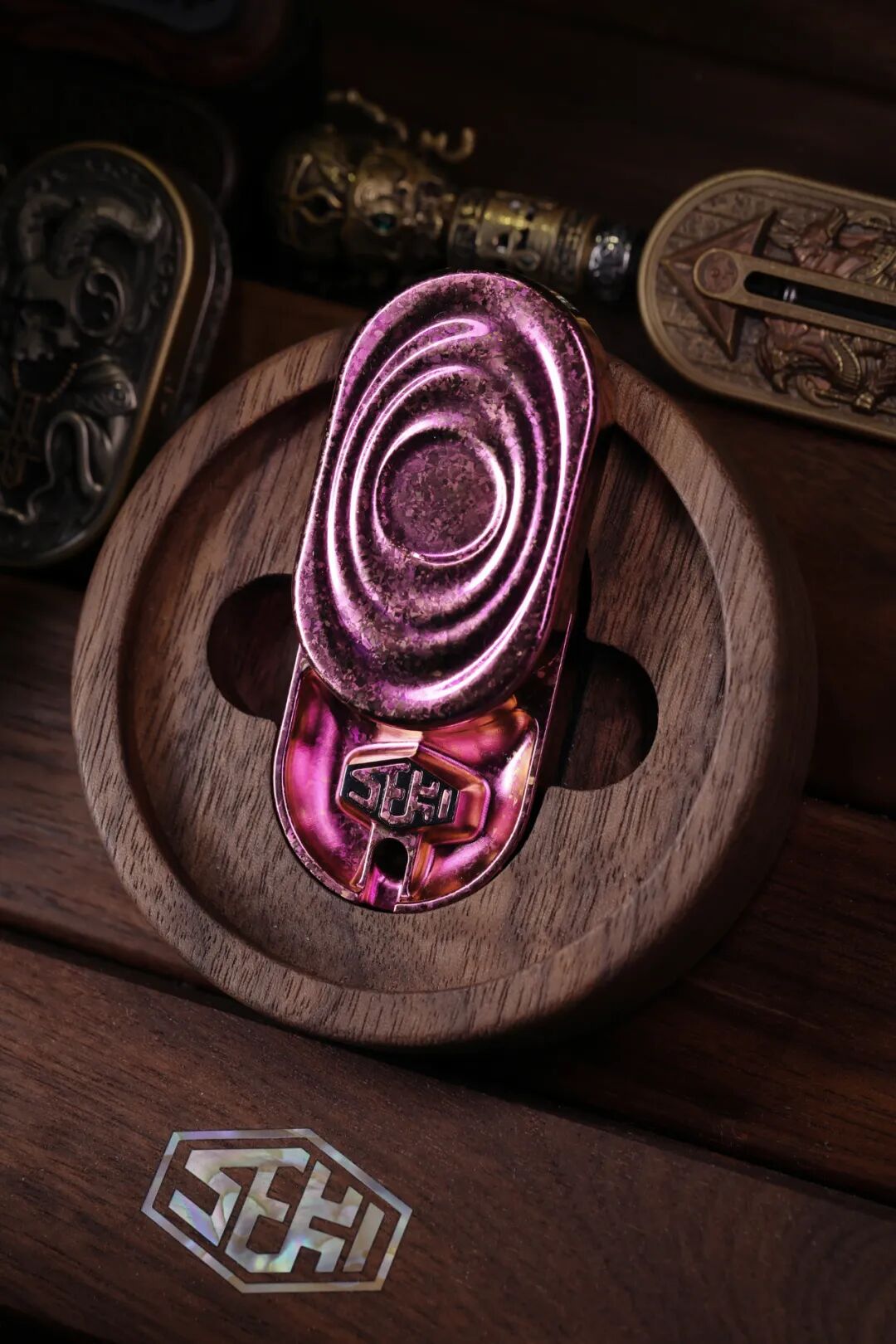
SEKI Bo 3.0 · Purple sample. The maker states that all photographs show samples; the actual item is the reference for appearance.
Xingqiu III: texture before colour
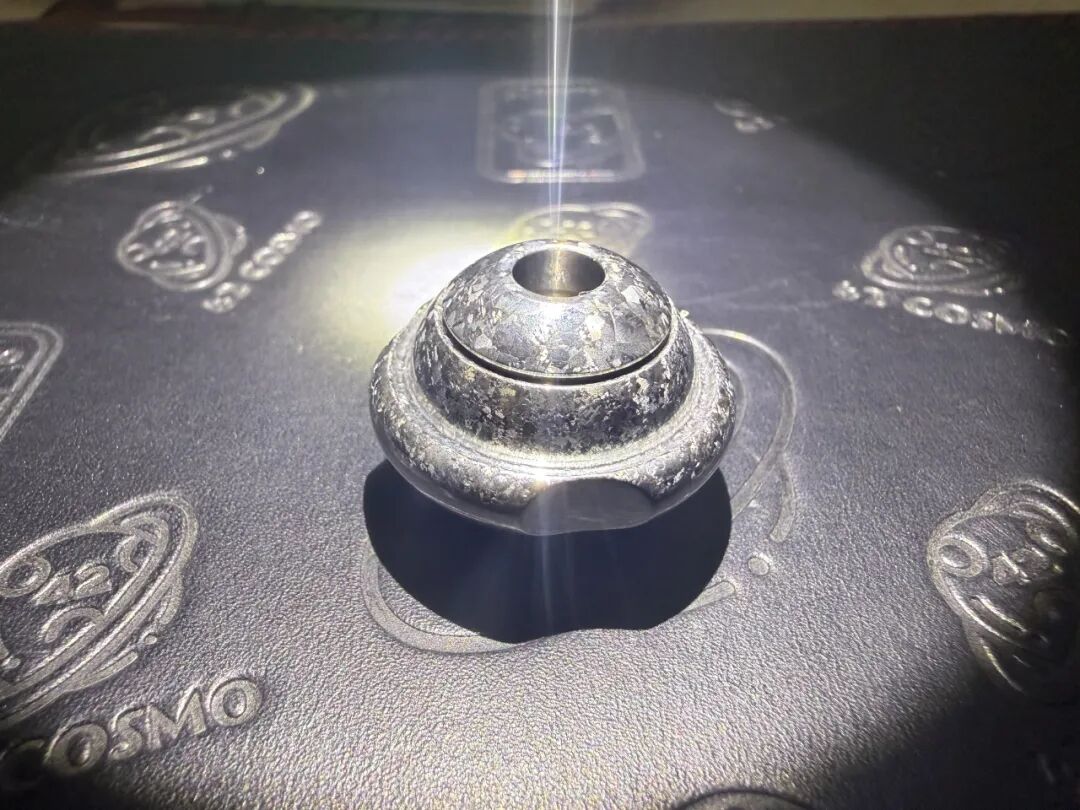
42COSMO Xingqiu III · Natural-colour crystallized titanium. Crystal patterns are visible without an added colour finish.
Crystal patterns without added colour
42COSMO’s Xingqiu III crystallized-titanium lanyard bead brings ring-shaped contours and a patchwork of crystal patterns to a small object. In the natural-colour photograph, light and dark areas are already visible on the silver-grey surface. Colour is not the only way to recognise this version’s texture.
42COSMO describes the material as titanium crystallized at high temperature, then acid-etched to reveal the crystal pattern and coloured to produce different finishes. This is the maker’s explanation for this product; the release gives no base-material grade, heat-treatment parameters or grain-measurement data.
This Xingqiu III release offered natural colour, green, purple, light blue, gold and dark blue. The maker also says the III design removes the earlier openwork structure to address hole misalignment and difficulty reaching the threaded fastener to tighten it. That is a product-design revision, rather than a property of crystallized titanium.
Chang Gong: crystal patterns in motion
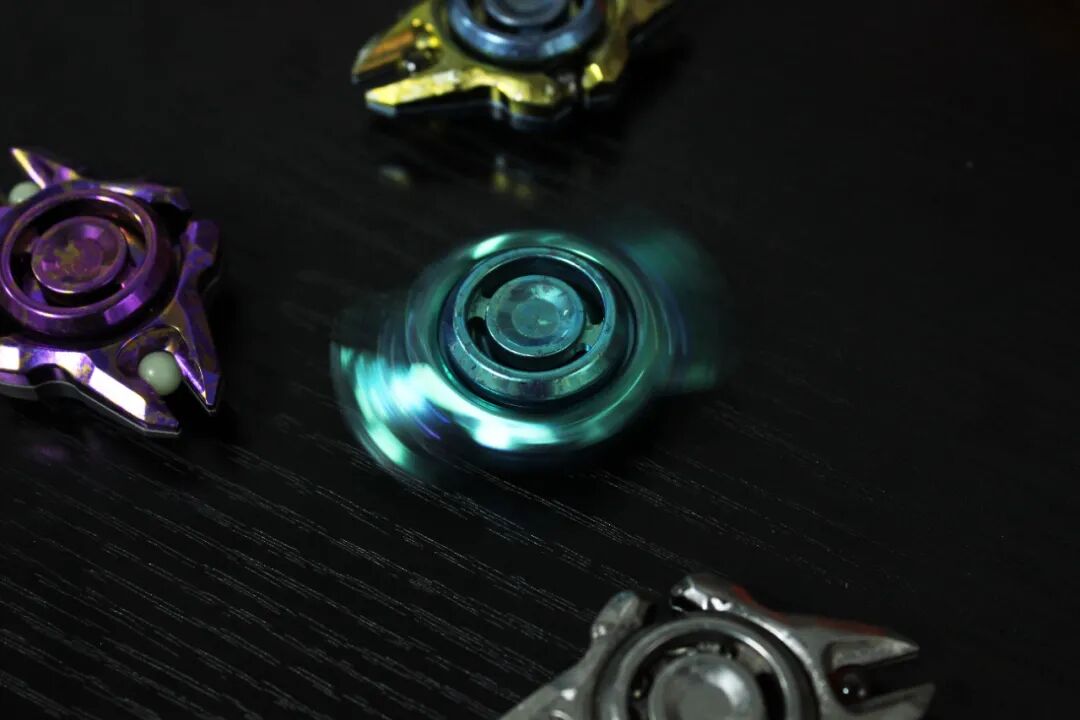
Mobius Chang Gong · A rotation photograph from the maker. Motion blur records the photographed moment, not a spin-speed or duration test.
Three processes named by the maker
Mobius explicitly lists polishing, acid etching and anodising for its crystallized-titanium Chang Gong release, highlighting the play of light during rotation. The release lists natural-colour, blue, gold, purple and green versions.
The spinner at the centre of the photograph produces a green blur, while the other colour versions beside it retain their stationary outlines. The image illustrates the visual effect the maker chose to show. It does not establish spin time or provide a hands-on assessment.
Here, crystallized titanium is the material name used for this version; polishing is a surface treatment, and anodising is the colouring process specified in this release. These terms describe different aspects of the product.
SEKI Bo 3.0: crystal patterns across waves
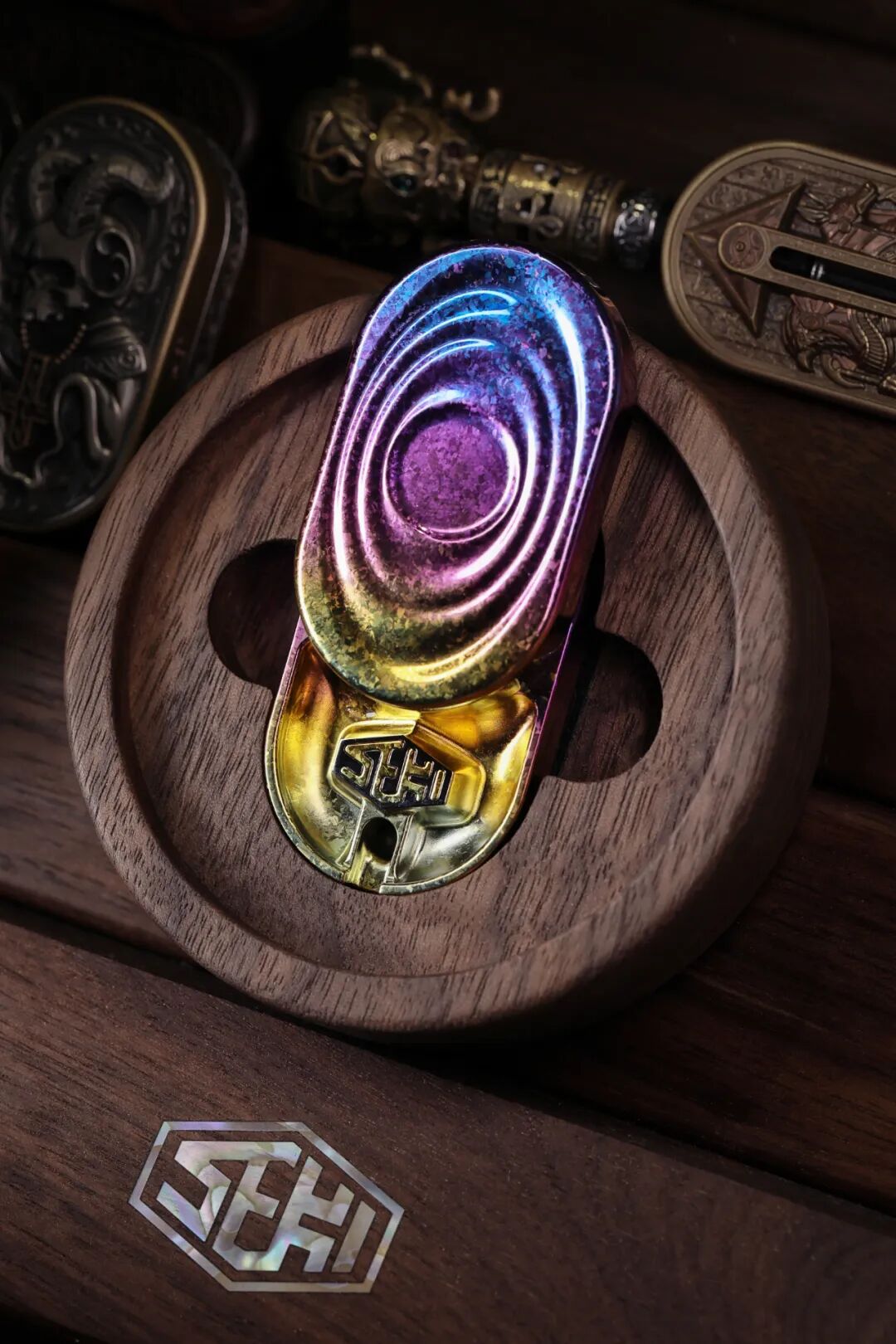
SEKI Bo 3.0 · Rainbow-gradient sample. The maker states that all photographs show samples; the actual item is the reference for appearance.
Read shape, surface and colour together
SEKI identifies crystallized titanium as the body material of Bo 3.0 and separately specifies a polished surface. In the photograph, the regular wave-like ridges belong to the product’s shape, while irregular patches of light and dark add another layer of texture. Both can be observed on this slider.
The release lists six base colours—purple, blue, gold, light blue, rose pink and lake green—plus a rainbow-gradient special colour. The opening photograph shows the purple sample; this chapter shows the rainbow-gradient sample, allowing a comparison of how colour falls across the curved ridges.
The maker explicitly states that all photographs show samples and that the actual item is the reference for its appearance. These images explain the colours and shape, but do not guarantee an exact match in hue or texture for a delivered product.
Crystal patterns, colour and grade are separate questions
Titanium anodising can produce interference colours through an oxide film. Surface-treatment company AlTiColor explains that its titanium anodising colours arise from interference rather than pigments. This provides context for the process named by Mobius, without establishing that every coloured crystallized-titanium product uses the same method.
For example, Chima’s Xiangmo 2.0 release uses the labels “natural colour” and “heat-coloured”; it does not specify anodising as the Chang Gong release does. Keep the maker’s actual description rather than inferring a process from a photograph’s colour.
The product descriptions used here do not give a verifiable base-material grade. Crystallized titanium therefore cannot be equated with a specific commercially pure titanium or titanium-alloy grade, nor does the name establish hardness, wear resistance or a better fidgeting experience. Before polishing, stripping colour or recolouring, establish the specific surface process and consult the maker’s guidance. These sources do not support a universal care procedure.
IN THESE FAMILIES
Swipe to exploreExplore the crystallized-titanium versions of these products.
PIECES IN CRYSTALLIZED TITANIUM
Each photograph stays with its specific version and shooting conditions.
ALL MATERIALS
Keep exploring the TRB material guides.
 Crystallized TitaniumYou are hereVIEW →Materials indexAlloys, polymers and finishesVIEW →
 ZircutiZircuti material guideVIEW →
 SuperconductorSuperconductor material guideVIEW →
Material background
AlTiColor: Titanium colour anodising · A surface-treatment company explains interference colour in titanium oxide films. Process background, not verification of these products’ grades or performance.
