

GoldSolid gold parts, inlaid details and gold-covered surfaces
In EDC, gold can form an outer ring, a small detail in a steel plate, or a surface layer over another metal. Its location and amount tell you more than a golden colour alone.
Zhuanyun, the Dragon Slayer plate, Horus in black and gold, and Zhangzhongbao illustrate four different material arrangements. Their gold content, finished weight and construction need to be read separately. Similar colours can conceal very different structures.
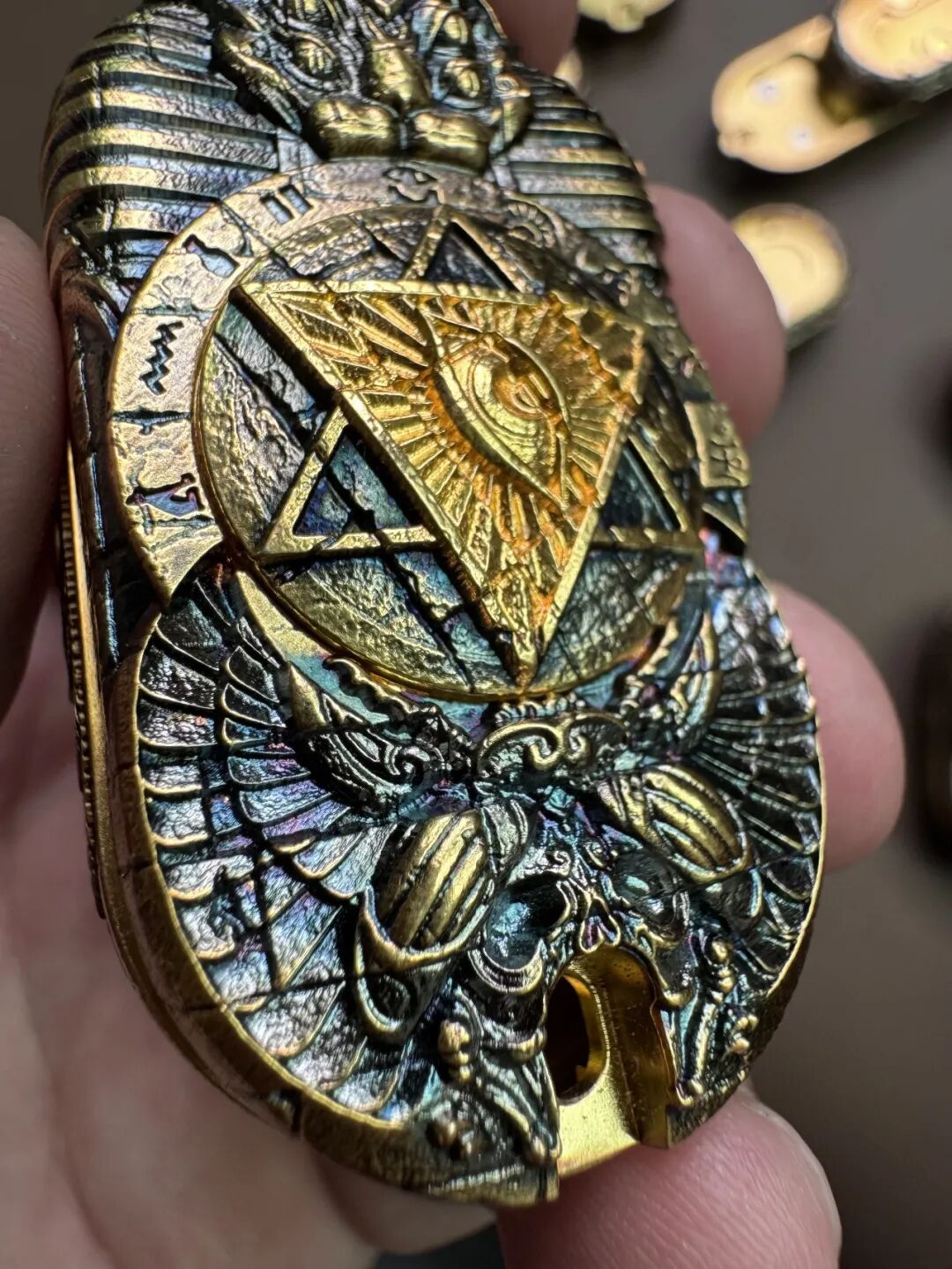
YESNO Horus Eye in its black-and-gold finish. The maker identifies a white-copper base with a gold surface layer; the appearance does not establish an all-gold object.
Zhuanyun: an 18K outer ring with different inner parts
YEDC separates the parts in its July 2025 introduction of the 18K collaboration version of Zhuanyun. The outer ring is 18K gold; the internal structure and inner ring are described as “high-standard titanium” with real-gold plating, without a specified titanium grade or purity. Similar colours inside and out do not make their underlying materials the same.
18K describes the fineness of a gold alloy. The Royal Mint explains it as 75% gold by mass; that definition is not a test result for this product. YEDC does not provide the outer ring’s separate weight, so the complete ring’s weight cannot be used to calculate its gold content.
The maker gives 6.8 g for a size-20 sample and an estimated 6–10 g across the offered even-numbered sizes from 16 to 30. These are complete-object weights: one sample measurement and one estimate across sizes. The described fuller feel and quieter sound than the LKS version also belong to this particular comparison.
Dragon Slayer: 0.4 g of gold in a 19.8 g steel-based plate
BPMODS introduced its Dragon Slayer plate as the first piece in its November 2025 one-off programme. It specifies a stainless-steel base, 0.4 g of inlaid gold and a total plate weight of 19.8 g. Gold is a local detail within the engraved image; steel forms the plate base.
The maker describes the hand engraving as “Linsai”, with dense drawing-like lines, and records 27 days of engraving for this piece. An engraving name alone does not identify a gold base. The explicit material statement separates an engraved, gold-inlaid plate from a plate made wholly of gold. Likewise, 0.4 g of gold and 19.8 g of finished plate answer different questions.
Horus in black and gold: a gold-bearing surface
Finished examples from the same Horus article. Its approximately 1.1 g gold figure is client-provided information, not something this photograph can verify.
Black and gold over a white-copper base
In its April 2026 Horus Eye article, YESNO identifies a white-copper base, a gold surface layer and an aged black-and-gold treatment. The photographs show bright raised details against dark recesses. They do not reveal the metal inside or establish the thickness of the gold layer.
The certificate image reproduced by the brand gives a conclusion equivalent to “surface contains gold”. Its remarks identify approximately 1.1 g of gold as data supplied by the commissioning client for the white-copper Horus Eye black-and-gold slider. That figure is client-provided information, not a gold mass measured and certified in the displayed report. The document’s authenticity has not been independently verified here.
The maker also promotes its thick gold-covering process and long-term wear performance, but the article supplies no reproducible wear test or layer-thickness data. These statements are not TRB testing and do not establish that every gold-covered fidget will resist wear or exposed base metal.
Zhangzhongbao: plated zirconium and special gold lettering
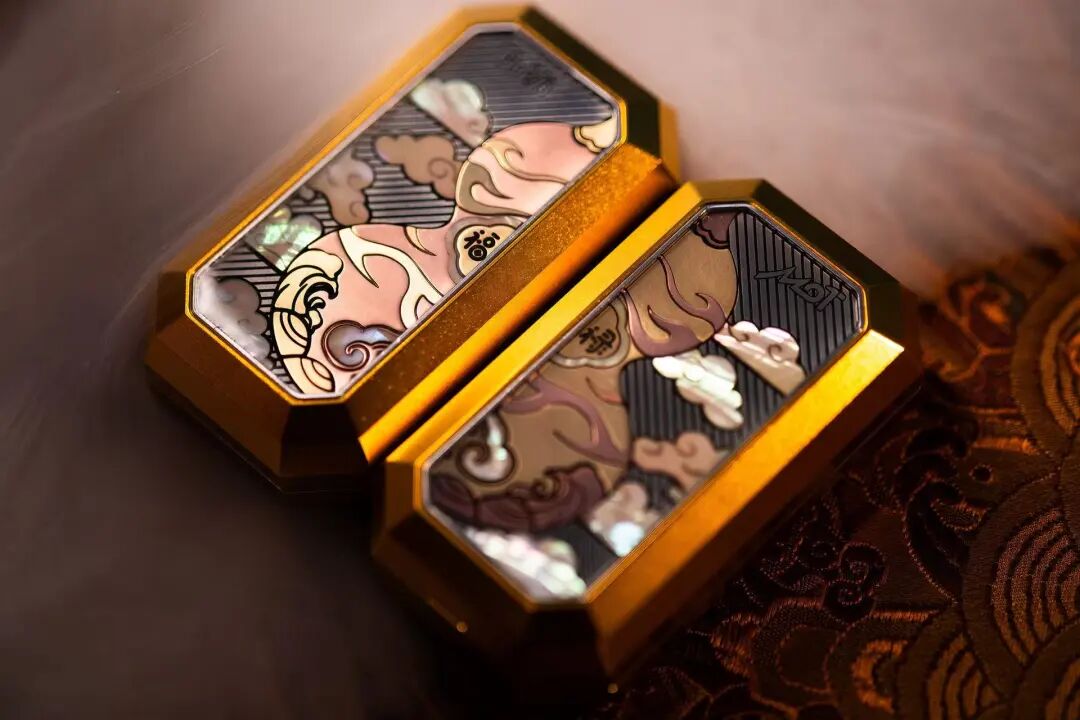
CC28 Zhangzhongbao Fulu Shou as shown in the launch article. The body and plate bases are described as zirconium alloy with a magnetic-washed, gold-plated finish. The pictured lettering is not independently identified as a pure-gold insert.
Read the base, plating and inlays separately
CC28’s launch description for Zhangzhongbao Fulu Shou specifies zirconium alloy for both the main body and the plate bases, with magnetic washing and gold plating. Golden borders, mother-of-pearl inlays and a clear covering layer form the appearance together. A gold-coloured surface is not evidence of a solid-gold body.
The same article separately announces ten pure-gold Fulu character inserts to be placed randomly in some pieces. That is a limited small-component record, not a feature established for every standard example or for the lettering in these photographs. A special stainless-steel-bodied giveaway at the end of the article is another configuration and should remain separate from the zirconium launch version.
Fineness, gold amount and finished weight
Fineness tells you the proportion of gold in an alloy. Gold amount tells you how much was used in a specified part. Finished weight includes the other metals and components. Zhuanyun’s 18K designation and the Dragon Slayer plate’s 0.4 g and 19.8 g figures describe different things.
Care also depends on the specific base, surface layer and inlay structure. There is no universal polishing or chemical-cleaning recipe for these examples. Follow the maker’s instructions for the particular piece when cleaning, repairing or taking apart plated or clear-covered parts.
IN THESE FAMILIES
Swipe to exploreExplore how Horus and Zhangzhongbao combine gold surfaces, base metals and inlaid details.
PIECES IN GOLD
Look at where gold is used in each configuration: on a surface or in a separately specified detail. These records do not indicate current stock.
ALL MATERIALS
Keep exploring the TRB material guides.
GoldYou are hereVIEW →Materials indexAlloys, polymers and finishesVIEW → ZircutiZircuti material guideVIEW →
 SuperconductorSuperconductor material guideVIEW →
Material background
886 by The Royal Mint: what 18K means · 18K means 75% gold by mass. It does not establish the fineness or gold amount in these EDC products.
