


Wait. Take 10% off
Lock 10% off now. Use it on any event item.
Apply code
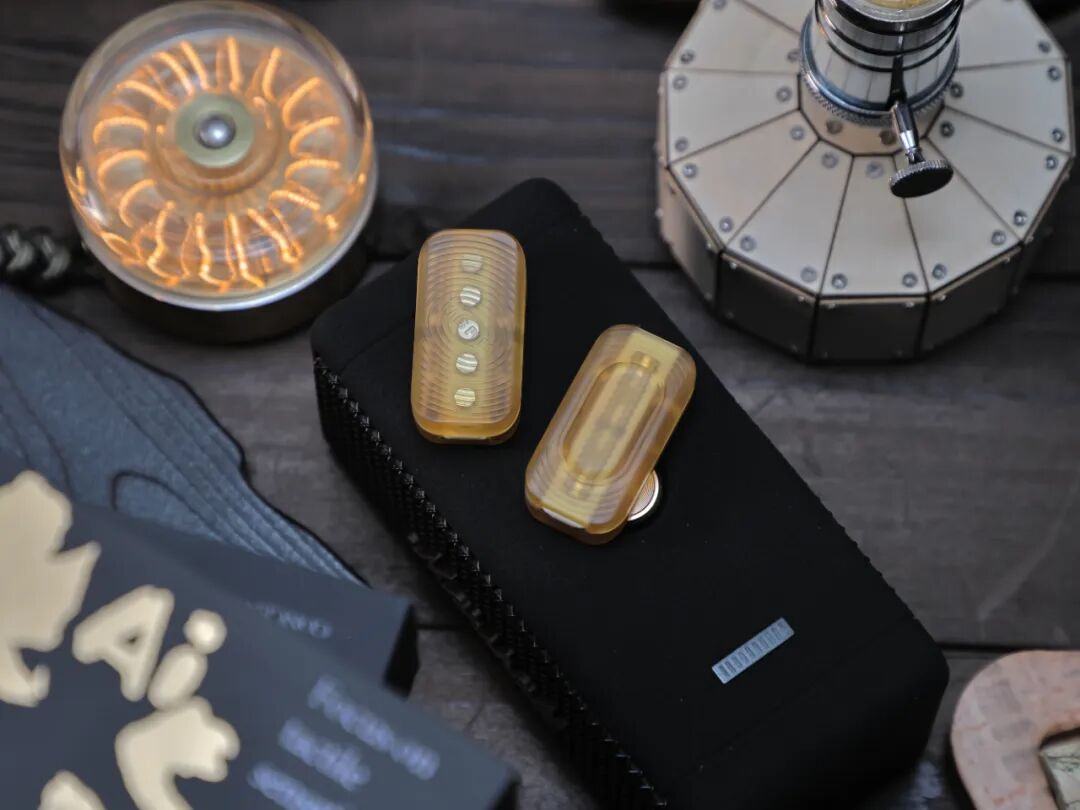
PEI, short for polyetherimide, is an engineering plastic with a familiar place in EDC: the amber slider that lets you see the magnets and shapes inside. Those visible layers are part of its appeal.
On WANWU's Defense, PEI gets a bright polish. On KAIS POPO, a fine blasted finish softens the look. The March Spinner takes it another way, putting amber and black PEI in different parts of the same piece.
Both halves belong to the PEI edition. Polished surfaces sit alongside tool marks retained in the pattern, serial number and logo.
PEI is often easy to spot in an amber, translucent slider. That look shows up in several of the pieces here, but PEI can also be made into black parts. Colour alone will not tell you what a part is made from.
You may also come across ULTEM, SABIC's trademarked material family with different grades and formulations. A product labelled PEI still needs a maker's specification to establish its resin brand and grade.
Keep three details separate: PEI is the material, amber or black is the colour, and polishing or blasting is the finish. PEEK is a different material.
This release uses a 320-grit blasted finish. The photo shows the exterior; it does not identify the Stepped or Dense feel configuration.
On the PEI Defense, polished surfaces bring out the amber colour and the layers underneath. Tool marks remain in the pattern, serial number and logo, giving the smooth finish some contrast.
For the June 2025 POPO release, KAIS specified a 320-grit blasted finish and described its appearance as somewhere between clear and opaque. That detail belongs to this release; another PEI piece may have a different finish.
The configuration matters too. POPO has separate PEI Stepped and PEI Dense entries. An exterior photo alone will not tell you which feel configuration you are looking at.
Amber PEI forms the body and central fastener; black PEI is used for the buttons and inserts. The beads are silicon nitride ceramic.
WANWU's June 2023 two-arm March Spinner uses amber PEI for the body and central fastener, with black PEI buttons and inserts. The beads are a separate material: silicon nitride ceramic.
That gives a small piece a clear light-and-dark contrast. When a description says black button, start with the part and then check its material. The colour and part name do not establish a new material or a coating.
The listed 64 g is the weight of this complete PEI and stainless steel configuration, including its other parts.
In this Taia Sword fidget slider, PEI forms the sheath and stainless steel forms the blade-shaped section inside. A fine blasted finish on the sheath puts the translucent plastic alongside a differently finished metal part.
The listed weight is 64 g for this complete configuration. That includes the PEI, stainless steel and the other parts, rather than just the sheath.
PEI does not always form the outer body. Leap's 80s retro series uses it for the push block, with G10 upper and lower bodies on the regular editions and engineered wood on the hidden editions. Those colourful outer bodies should not be used as examples of PEI colour.
WANWU lists its polished PEI DRUMS lanyard bead at about 4.5 g. That tells you something about this bead; a slider or a piece that combines PEI with metal needs its own weight figure.
For everyday care, start by removing surface dust and wiping gently with a soft cloth. A polished surface can pick up fine scratches over time; WANWU also flags this for the polished PEI DRUMS bead.
For cleaning fluids, lubrication or disassembly, follow the maker's instructions for that piece. Strong solvents can cause stress cracking in PEI. A resin's heat rating does not mean a complete EDC piece, with magnets, bearings and other parts, can be heated or cleaned in the same way.
Even care advice in the same product announcement can apply to a different material. WANWU describes a walnut-oil treatment for the G10 Defense; that is not a PEI care instruction.
These families include documented PEI editions or parts. The captions refer to the specific releases shown.
Explore the specific editions and parts below. These are product records, not a list of current stock.




Keep exploring materials
PEIPolyetherimide / you are hereVIEW → Materials indexBrowse the TRB material guidesVIEW →
 ZircutiZircuti material guideVIEW →
 SuperconductorSuperconductor material guideVIEW →
SABIC: ULTEM resin portfolio · Material names, grades and formulations. Product-specific resin identification still comes from the maker.
Ensinger: Engineering Plastics Manual · PEI and solvent exposure. Resin properties do not establish cleaning instructions for an assembled product.