

White copperFrom engraved grounds to aged outer plates
Start with where the material is used, then look at its finish.
In EDC, white copper can form a polished body, a relief plate, an inlay ground or an outer plate. Its relationship with copper, brass and zirconium often tells you more than colour alone. The product sources do not disclose alloy compositions; this page retains their name, white copper.
Three sets of photographs anchor the discussion, followed by examples of mirror polishing, DLC and gold plating. Product descriptions identify the material and part; photographs show how those choices appear together.
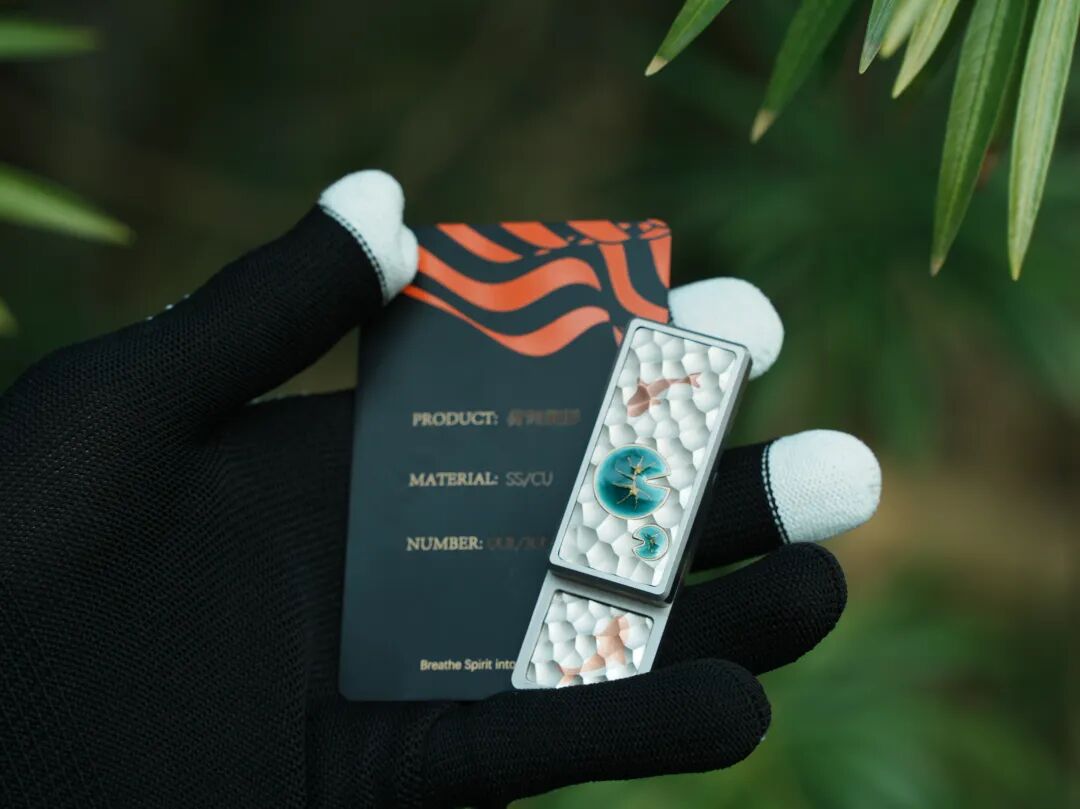
SAS Hejian Liying: white copper forms the ground of both plates, with copper koi and brass lotus-leaf inlays.
White copper as an inlay ground
Both white-copper plate grounds are visible when open. The body is stainless steel, with copper koi and brass lotus-leaf inlays in the plates.
White copper as an inlay ground
SAS’s Hejian Liying, a koi-and-lotus design in the Chunjin slider series, assigns different roles to its metals. The body is stainless steel. Both decorated plates have a white-copper ground, with copper koi and brass lotus-leaf inlays. The maker uses machine engraving to evoke a shimmering pond surface; white copper forms the broad background that carries the fish and leaves.
Opening the slider reveals the patterns on both plates. In these photographs, the leaves are green with golden edges, while the fish have a copper-red tone. These are observations of this particular finish; the source does not identify how the leaves were coloured.
Aged relief and version differences
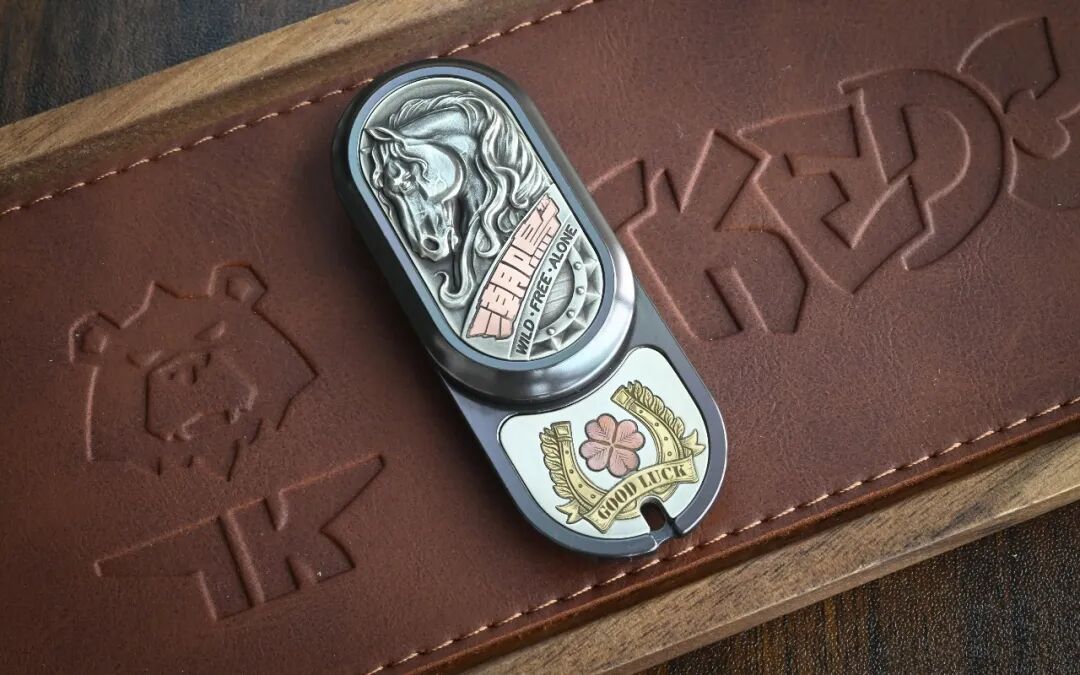
Chaoming Poxiao (Dawn), in its standard white-copper plate configuration: aged and polished relief plates on a heat-blackened zirconium-alloy body.
Aged relief and version differences
TK’s sixth-generation Chaoming Poxiao (Dawn) pairs a heat-blackened zirconium-alloy body with large and small white-copper plates. The relief is aged and polished, creating contrast between the horse, horseshoe and surrounding ground. TK also notes that these white-copper plates may slowly oxidize with environmental humidity and develop changes in colour.
The photograph shows Poxiao’s standard white-copper plate configuration. That release also included 10 randomly allocated units with coloured titanium plates instead. The standard Jiye (Polar Night) version used zirconium-alloy plates. Match the version, plate configuration and finish together. The maker’s approximately 77 g figure refers to the complete standard Poxiao configuration, not to the plates alone.
White-copper plates over a copper body
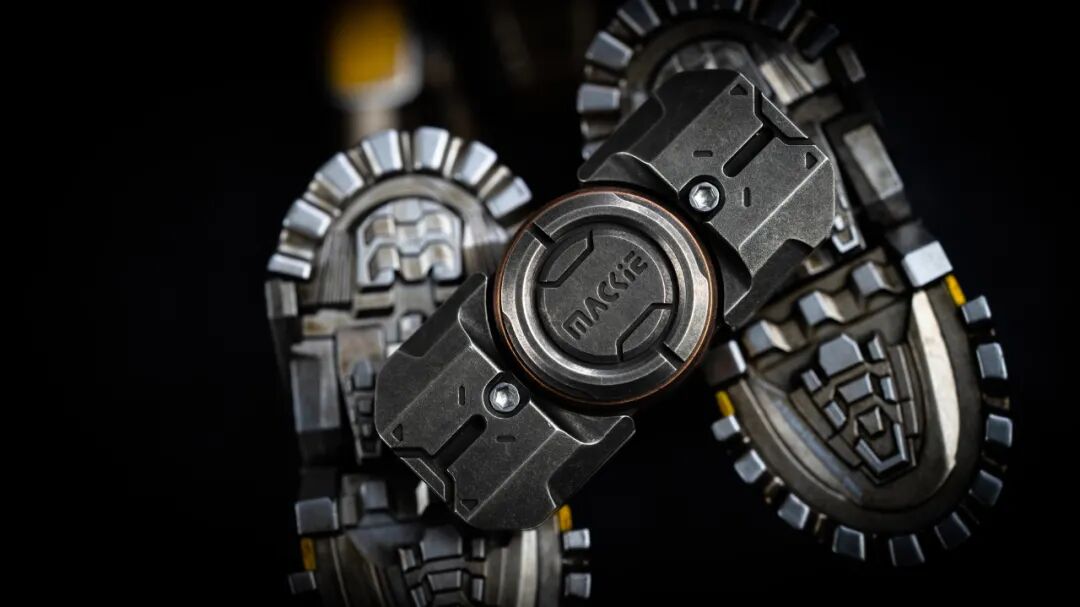
Captain’s white-copper version pairs white-copper outer plates with a copper body and a stonewashed, aged finish.
White-copper plates over a copper body
MACKIE Captain’s white-copper version uses white copper for the outer plates and copper for the body. The maker describes this version as stonewashed and aged. In the photograph, much of the outer surface is dark, with brighter lines along the edges and copper-coloured layers visible underneath.
White copper therefore need not appear as bright silver. This Captain’s appearance reflects both the placement of its materials and the aged finish. The example is the white-copper plate configuration released in 2021; the whole product is not white copper, and the dark plates should not be identified as zirconium by colour.
Polish, coating and base material
Mirror-polished white copper can also form the main exterior. MOT’s white-copper Xuantian Hu has a mirror-polished white-copper body. Its bottom rotor is also white copper, with a black DLC coating, while the centre post is stainless steel. Here, the bright body and black rotor differ primarily in their surface treatment.
In GD’s polished-PEI Shangshangqian release, the Xiangrui plates use gold-plated white copper, while the Caiqi plates use gold-plated brass. Their shared gold colour does not mean that their base metals match. The maker noted that tiny pores or hairline marks could remain after the multiple finishing stages and 24K gold plating.
ZERO ONE’s POL white-copper-and-copper VIP version keeps a two-metal contrast: a polished white-copper body with aged, hammer-textured copper plates. Before assessing or caring for such mixed-material pieces, identify the part and its finish. A method intended for polishing bare copper cannot automatically be applied to gold plating, DLC or an assembled mechanism.
What the name establishes
This page follows the product sources’ term white copper. They do not provide chemical compositions or grades, so the products are not collectively assigned to either a copper-nickel or a copper-nickel-zinc alloy.
Material classifications are more specific than appearance-based names. The Copper Development Association distinguishes copper-nickel alloys from copper-nickel-zinc alloys, also called nickel silvers. Identifying the actual alloy requires composition data or an explicit material specification; silver, dark grey and gold-coloured photographs cannot supply that information.
IN THESE FAMILIES
Swipe to exploreThese product families use white copper in three different places: beneath inlays, in relief plates and in outer plates.
PIECES IN WHITE COPPER
Look closer at the parts: an engraved ground, a standard relief configuration and aged outer plates.
ALL MATERIALS
Keep exploring the TRB material guides.
 White copperYou are hereVIEW →Materials indexAlloys, polymers and finishesVIEW →
 ZircutiZircuti material guideVIEW →
 SuperconductorSuperconductor material guideVIEW →
Material background
Copper Development Association: Types of Copper-Nickel Alloys · Explains the distinction between copper-nickel and copper-nickel-zinc systems; it does not establish the alloy grades of these products.
