

KnucklesUnderstand the form, fidget components and decorative derivatives.
Single-finger, two-finger and multi-finger describe the body. Plates, buttons, joysticks and rollers raise different questions: which part moves, what feedback does it provide, and how does it relate to the body? Start there, then explore versions, materials and decorative derivatives.
Image unavailable.
Identify the moving part
“Has fidget features” is only a starting point. Plates, buttons and joysticks respond to different actions, while decorative parts may be fixed.
Three components, three different actions
MTAK × BTMCL’s GAMER-TAK makes the distinction clear: it has a plate described as push-flickable, four contact buttons and a simulated joystick. Identify each part, then distinguish sliding the plate, pressing a button and moving the joystick. Four buttons do not automatically mean four distinct play modes, and the parts need not move together.
Identify the three fidget components
Highlight the plate: the maker describes this magnetic plate as push-flickable.
Highlight the button group: four physical contact buttons, not four separate modes.
Highlight the joystick: the maker's illustration indicates movement in different directions, separate from the plate and buttons.
Component zones based on GAMER-TAK’s 2021 material. Positions and arrows are conceptual, not a physical layout, measured travel or linked motion.
Game-controller styling is not a game console
GAMER-TAK uses circuit-board elements in a resin plate, with separately specified buttons and joystick. These are physical fidget components and a decorative design; a visible circuit board does not establish that the object can run electronic games. A still image also cannot establish sound levels or simultaneous operation.
How the forms are grouped
Single-finger, two-finger and multi-finger describe the body. Sliding plates, rollers and flipping panels describe features that may accompany it.
Single-finger, two-finger and multi-finger
The guide groups documented bodies as single-finger, two-finger or multi-finger. WM explicitly describes WARM as single-finger; WANWU describes Behemoth as a two-hole knuckle; MISTY explicitly describes PrimeMover 2.0 as a four-finger design, placing it within multi-finger forms. “Full-palm” is not automatically a synonym for “four-finger.” If the body is not identified clearly, its subgroup remains unspecified.
Two visible holes may have different purposes
A hole's purpose matters more than the total count. One specific MTAFK announcement describes two lanyard holes, rather than two finger openings. That wording does not establish a two-finger body. Finger openings, lanyard holes and decorative openings must be distinguished; a similar outline also does not turn a pendant into a knuckle.
Locate the action and feedback
A fidget action may belong to a component on the body or to a separate object that can be used on its own.
Rollers can be independent fidgets
Image unavailable.
AMMO's March 2026 zirconium Mechanical Decoder announcement describes an independently usable roller with two selectable feedback styles: distinct detents and dense feedback. Those features belong to this roller and version. They are not automatically default features of a compatible body, nor evidence for a different magnetic version.
Read “detents” as individually distinguishable feedback steps, and “dense” as a closely spaced sequence of feedback. These are word meanings, not measurements of this roller; no shared density threshold across products is established here.
Flipping panels: identify the moving piece
MTAK's FUSION F-01 illustration names the body, shell and flipping panel as separate components. The flipping panel is the moving fidget part; the word “plate” alone does not establish that a part flips. The maker mentions magnets and a washer-bearing arrangement, along with a sound description. These are version-specific design statements, not a sound-level comparison or an audio demonstration.
Plates differ in construction and function
A body and plate may look separate, yet be joined in very different ways. Read the version-specific construction description.
One-piece and separate-plate construction
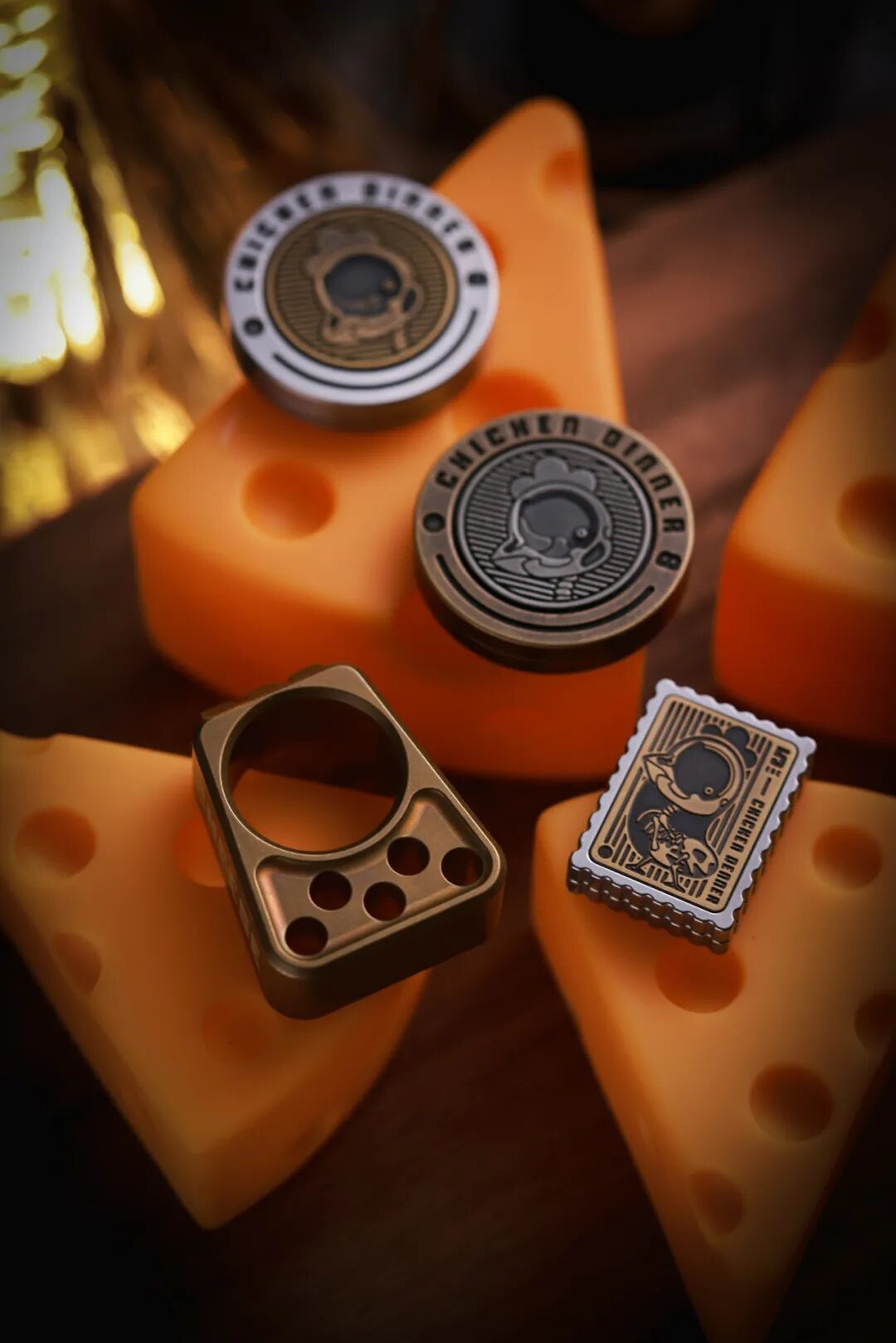
ACEdc × OneBean's original Cheese Knuckle announcement distinguishes two versions. Its one-piece version uses one material throughout; its separate-plate version has a body and plates joined mechanically without adhesive. For this model, “separate plate” describes construction. It does not establish tool-free removal or compatibility with plates from other products.
A separate-looking plate may be permanently bonded
Rainbow Coffee CHEERS provides a useful counterexample. It has a titanium body and plates made with coffee particles and resin, but the maker explicitly states that these comparatively fragile plates are permanently bonded with resin adhesive. Compare it with the separate-plate Cheese version: having a plate does not, by itself, mean that the plate is replaceable or movable.
Similar plates, different connections
Separate-plate Cheese: the maker describes a mechanical, adhesive-free connection. This identifies the relationship without showing removal steps.
Rainbow Coffee CHEERS: the resin plate is permanently bonded to the body. A layered appearance does not establish removability.
A comparison of two specific versions. The blocks represent plates, not engineering details of their connections.
A material belongs to a named part
The FUSION F-01 specification illustration separates its titanium body and shell from its zirconium flipping panel. Rainbow Coffee CHEERS similarly distinguishes the titanium body, resin plates and CERAKOTE finish. A zirconium panel does not make the whole body zirconium, and a surface finish is separate from the body's material.
Read the identity and version
A shared name, outline or series does not establish the same product identity.
A pendant derivative has its own identity
MTAK explicitly presents CHEERS 60% as a pendant scaled from the one-piece CHEERS design, illustrating necklace, bag-charm and lanyard-charm uses. Its identity is a pendant derived from CHEERS; the source design's knuckle or bottle-opening functions do not automatically carry over. The percentage also does not replace actual dimensions for the pendant.
Start with the object's identity
The original design is a complete object. Its form, materials and documented features belong to a specific body and version.
Plates, shells and flipping panels are named parts; a part's material or motion does not describe the whole body.
CHEERS 60% retains a design relationship to the original, but is explicitly presented as a necklace, bag or lanyard pendant.
Read these as three object relationships, not stages in dismantling or transforming one product.
Three questions to keep with each record
First identify the object: a complete body, a component or an independent derivative. Next identify its generation, material and construction version. Finally check whether a feature belongs to that object or only appears on a compatible object or in an illustration. The original Cheese announcement also says that inlays were not a factory configuration at that time; an inlay photograph is not proof of a series-wide standard.
A map of forms, components and identities
The three form groups sit alongside information about features and construction. Pendants and independent rollers keep their own identities.
Body forms
Multi-finger
Includes documented four-finger bodies; arbitrary visible holes do not determine the group.
Read the explanation →
Fidget components
Construction and relationships
One-piece / separate plate / permanent bond
Check the actual connection; the outline alone does not prove removability.
Read the explanation →
Glossary
No matching terms.
Single-finger
A body explicitly described as single-finger; lanyard holes are not counted.
Two-finger / two-hole
Two documented finger openings in the body; two lanyard holes are different.
Multi-finger / four-finger
Multi-finger includes documented four-finger bodies; “full-palm” alone does not establish four.
Lanyard hole
An opening for a lanyard, distinct from the finger openings used to describe the body.
Body
The identified main object; its components and pendant derivatives have separate scopes.
Plate
May be fixed decoration or a moving fidget part, depending on the model.
Push-flick action
The maker's description of GAMER-TAK's magnetic plate, rather than a feature of every plate.
Contact button
The buttons shown for GAMER-TAK; button count is not a count of distinct play modes.
Simulated joystick
A physical movable control; its appearance does not establish an electronic gaming function.
Flipping panel
A named moving part in FUSION F-01, separate from the body and shell.
One-piece
The original one-piece Cheese version uses a single material throughout; this is version-specific.
Separate plate / mechanical attachment
The Cheese version has mechanically attached plates; this alone does not establish unrestricted removal or interchangeability.
Permanent bond
Rainbow Coffee CHEERS plates are permanently bonded with resin adhesive.
Roller
The Mechanical Decoder can be used independently; its features do not automatically belong to a compatible body.
Detent / dense feedback
Read “detents” as individually distinguishable feedback steps, and “dense” as a closely spaced sequence of feedback. These are word meanings, not measurements of this roller; no shared density threshold across products is established here.
CERAKOTE finish
The finish on Rainbow Coffee CHEERS' titanium body, recorded separately from the underlying material.
Pendant derivative / 60%
CHEERS 60% is a pendant derived from one-piece CHEERS; the original functions do not automatically carry over.
All categories
Category overview →Explore movement, construction and terminology across all six guides.
 Fidget SliderSliding movement, detents and combined play.Read guide →
 SpinnerSpin, tactile feedback and ways to hold or support a spinner.Read guide →
 Fidget RingTurning feedback, construction and ring dimensions.Read guide →
 Haptic CoinTurning, pressing and different feedback structures.Read guide →
 KnuckleGrip forms, moving parts and feedback.You are here
 Knives & ToolsBlade formats, locking mechanisms and everyday tools.Read guide →
