

Spinner
A spinner is a handheld or supported toy whose body rotates around a centre or contact point. Grip buttons, bearings, moving arms and optional feedback parts have distinct roles in the documented configurations.
Maintained by TRB Creation · Page updated
Start with a flick. Explore spin, moving arms, linked motion, ring play and sound.
Image unavailable.
Start with one spin
Separate what you hold from what turns. That makes the later modes easier to understand.
Hold the buttons. Flick the body.
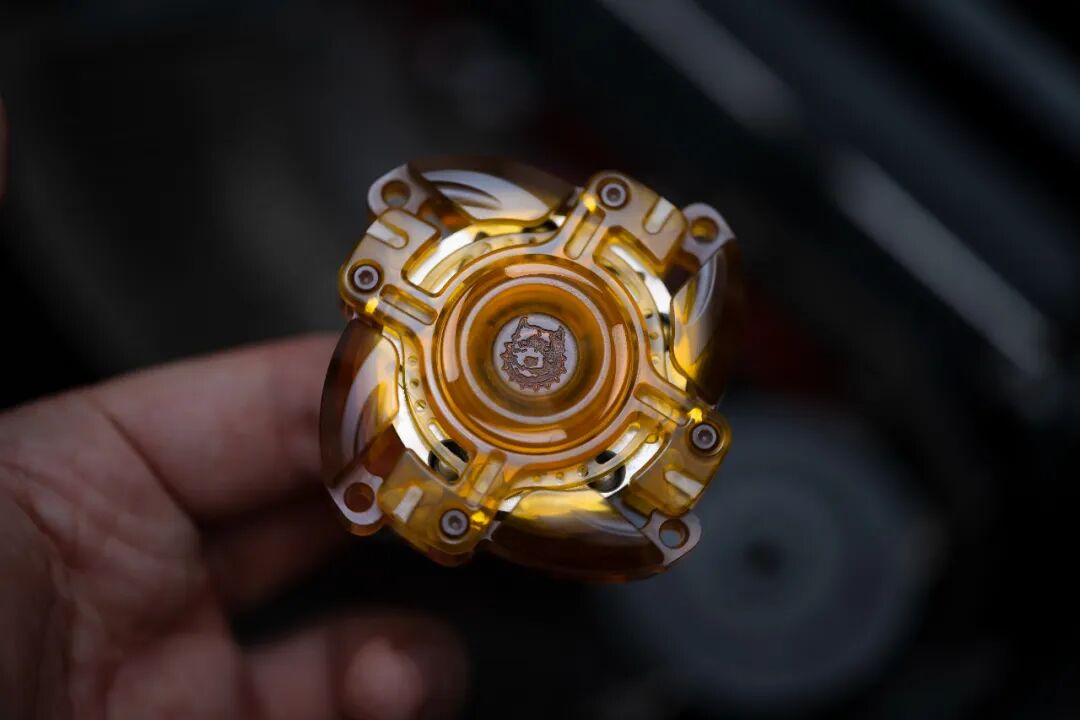
On a typical button-held spinner, your fingers hold the centre buttons while the body turns around them. DJG Xuandong is a useful example: recessed buttons provide the grip, a three-arm body gives you flicking points, and an R188 bearing sits at the centre. The buttons and the bearing do different jobs.
What stays still, what turns
The gold centre represents the grip buttons. The teal shape represents the surrounding body.
Flick the body. Its angle changes while the centre remains your grip.
The body turns around the centre. Your gripping fingers do not have to travel around with it; the bearing supports the relative rotation.
A conceptual view of a typical button-held spinner, not Xuandong's exact shape, a teardown or a speed test.
Find what you hold and what moves before decoding the product name.
Spin-focused and feedback-focused
Spin-focused designs put the turning experience first. Feedback-focused designs emphasise what you feel while turning, including linked parts and opening arms. DJG describes Xuandong as a speed-focused spinner. These are ways to explore the category, not a standardised speed rating or a claim that other spinners have no tactile feel.
Configuration details
A short product title may leave out features. Check the actual design and configuration.
Three ways to hold or support it
Pinched grip, finger-through play and supported tabletop spinning change how you use the toy. They do not all belong to one model.
Ring play: a finger through the centre
A ring spinner has a centre opening suited to finger-through play. Genex Cixuan 1.0 also uses a dedicated handle attachment for a pinched grip or supported tabletop spinning. Ring play depends on the actual opening and design. Removable buttons alone do not make every spinner suitable for it.
Where is it supported?
Your fingers grip the central buttons while the surrounding body turns.
Ring play uses an opening designed for a finger. Check the design and fit; simply removing buttons does not establish suitability.
A spinning top is supported at its bottom contact. Drones uses a bottom ball against a dedicated base.
Three support relationships, not conversion steps for one toy. Check each model's supported modes and accessories.
Finger-through play is a way to hold a spinner, not simply another name for a decorative ring.
A spinning top: support at the surface
A spinning top is supported from below. LAUTIE Drones provides an example with a large bottom ball and a dedicated base. That contact ball is different from the balls inside a bearing. Tabletop use does not identify one universal mechanism: Cixuan's handle-and-base arrangement is a different setup.
Configuration details
Drones belongs to LAUTIE's Bees series. No spin-time comparison is implied.
One spinner can offer more than one route
Grip and motion can overlap. A spinner may offer both opening arms and ring play, with different setups for each. Check the exact model, generation and installed parts before assuming that every product in a series offers the same modes.
Configuration details
The mode and the parts needed to use it should be checked together.
What changes while it turns
Some changes happen in the outer arms, others between linked parts, and some can be heard.
Linked motion: more than one moving part
Image unavailable.
Linked motion adds a relationship between moving parts. KTS describes double-ring linked motion in its Origin PEI edition, with a PEI exterior and solid brass weights inside. The useful distinction is between the whole body turning and additional movement between parts. Other linked spinners may achieve that in different ways.
Configuration details
A linked-motion label does not specify a gear train, magnetic coupling or rotation ratio.
Opening arms and locking them
Image unavailable.
Opening-arm play lets the outer plates move outward. YESNO RA offers both opening and locked-arm modes. The same product can therefore emphasise moving plates or turn with them held in place. Opening, closing and locking are different actions; visible plates alone do not explain how or when they move.
Opening and holding the arms
Start with the outer plates close to the body. They are separate from the central grip buttons.
The plates move outward, changing the silhouette and their range of movement.
Locking restrains plate movement while the body can still spin. This diagram does not specify RA's actual lock position or release method.
This compares free and restrained plate movement, not RA's arm count, actual hinges, automatic-opening conditions or assembly procedure.
A tuning fork adds sound
Image unavailable.
Lingyin adds a tuning fork to the spinner. Its instructions describe balls striking the fork during vertical spinning; when switching quickly to horizontal spinning, the ball noise disappears, leaving the fork's ringing tail. Changing the magnet count adjusts the triggering force. The sound therefore depends on orientation and setup as well as the fork itself.
Configuration details
The orientations describe the maker's stated modes. Sound and triggering vary with the actual setup.
Play balls: another way to configure it
Play balls go into positions designed for them, such as a cavity or a button assembly. HOPE Zheyu uses 13 mm balls in its documented configuration; S-ONE SuanQ-S describes three 6 mm balls. Those are product-specific sizes, not a universal accessory fit or a count of the balls inside the central bearing.
Ask where the ball goes before comparing size, material or feedback.
The setup can change the play
Image unavailable.
SuanQ-S shows why setup matters. Its pins can restrict opening on one side. With steel play balls installed, flipping its orientation changes the reported vibration. Its buttons can also provide separate feedback with suitable balls. Read the body, buttons, pins and play balls as separate parts, then check what is installed.
Configuration details
Descriptions of vibration, damping and quietness apply to the stated setup, not to every product made from that material.
Read the parts separately
Similar-looking parts may do different jobs. Locate each one before comparing specifications or compatibility.
Buttons, bearing and bearing retainer
The buttons are the grip. The bearing supports relative rotation. A threaded bearing retainer holds the bearing in place. A press-fit design instead retains it through a tight fit in the mounting bore. Replacing buttons and replacing a bearing are different changes.
More than one part at the centre
Distinguish the inner and outer rings. They allow relative rotation; the bearing is not the grip button.
Buttons provide the finger-grip surfaces. The separated arrangement explains roles, not an assembly sequence.
A retainer secures the bearing. Other designs use a press fit, so the same retaining ring is not present in every spinner.
A part-role diagram, not measured geometry, threads or compatibility specifications for a particular product.
Three different jobs for a ball
Bearing balls sit inside a bearing. Play balls occupy positions intended for extra feedback. A bottom ball on a top such as Drones contacts the supporting surface. Their sizes, materials and roles should be checked separately. Colour alone does not establish the material.
A ball can do different jobs
These sit between the bearing rings and act as rolling elements.
These occupy designated positions to add play or feedback. The positions shown are only a role diagram.
This sits beneath a spinning top and contacts its support, as documented for Drones.
Colours distinguish roles only. They do not specify materials, actual counts, dimensions or interchangeability.
Which part is made from that material?
A material label can leave out a mixed construction. Xuandong has a documented stainless-steel body with PEI buttons. KTS Origin PEI includes brass weights. Lingyin also separates the body from its replaceable tuning forks. Check whether a material describes the body, grip, weights or fork.
A material name is not a complete parts list.
From a preferred action to a product
Start with the action you enjoy, then check what the selected version actually includes.
Choose the action, then check the setup
For straightforward spinning, look at the grip and body shape. For moving arms, check opening and locking modes. For sound, check how the fork is triggered. For ring or tabletop play, check the opening or support arrangement. Then confirm the exact body, buttons, bearing and accessories on the product page.
Use the product and catalog links below to explore the specific object that interests you.
A map of spinner play
One product may cross several branches. Read its category, grip, motion and parts separately.
Category routes
Motion and sound
Opening / closing / locking arms
Opening, returning and holding in place are distinct
Read the explanation →Tuning-fork feedback
A feedback structure rather than another branch in this map
Read the explanation →
Shape and setup
Body / buttons / bearing / accessories
Check roles and compatibility separately
Read the explanation →
Glossary
No matching terms.
- Buttons
- The grip components held between your fingers; distinct from a bearing retainer.
- Bearing
- The component supporting relative rotation. Check its specification and the materials of its rings and balls separately.
- Bearing retainer
- A threaded retaining ring used to hold a bearing, rather than the buttons used for grip.
- Press fit
- A bearing retained by an interference fit in its mounting bore.
- Spin-focused
- A category focused on flicking and spinning, not a standardised speed rating.
- Feedback-focused
- Play centred on the feedback felt during rotation, including linked and opening-arm designs.
- Linked motion
- Related movement between parts; the exact relationship depends on the product.
- Opening arms
- The action or play of moving outer plates outward.
- Locked-arm mode
- A mode that holds the plates in place; RA documents both open-arm and locked-arm modes.
- Ring spinner
- A spinner designed for finger-through play at its centre opening.
- Spinning top
- A top supported at its bottom contact; Drones uses a bottom ball and a dedicated base.
- Tuning fork
- A structure used for audible feedback, with triggering that varies by design.
- Play-ball configuration
- Adding suitable play balls to designated positions, cavities or buttons; separate from bearing balls.
- Horizontal / vertical spinning
- Descriptions of orientation. Lingyin uses them to distinguish the ball noise from the remaining fork tone.
- Arm count
- The number of arms or lobes around the centre, such as two or three. It describes shape, not the full set of play features.
- Setup
- The actual combination of body, buttons, bearing and accessories. A supported mode is not necessarily installed.
Examples and more spinners
Start with RA and Ling Yin from the guide, then compare the other named spinner examples. Pictured configurations may differ from the original introductions; included parts are specific to each documented version.
 Ra BrassYESNO · Guide example · pre-owned RA in brass; check contents and condition
 Ling YinJUZHEDC · Guide example · Ling Yin; check the selected material and version
 Zeus XWANWU · More spinner examples; check the configuration
 NoizLAUTIE · More spinner examples; check the configuration
 NUCLEAR STATIONWANWU · More spinner examples; check the configuration
 OracleMOT · More spinner examples; check the configuration
No matching products.
Families on recordAcross all brands
Browse all 25 entries from the existing spinner directory, in their original order. Open a documented family guide where available; other entries remain catalogue references.
No matches. Try another name.
All categories
Category overview →Explore movement, construction and terminology across all six guides.
 Fidget SliderSliding movement, detents and combined play.Read guide →
 SpinnerSpin, tactile feedback and ways to hold or support a spinner.You are here
 Fidget RingTurning feedback, construction and ring dimensions.Read guide →
 Haptic CoinTurning, pressing and different feedback structures.Read guide →
 KnuckleGrip forms, moving parts and feedback.Read guide →
 Knives & ToolsBlade formats, locking mechanisms and everyday tools.Read guide →
Related family guides
Open this family page.
No family guide is currently mapped to this catalogue entry.
No family guide is currently mapped to this catalogue entry.
No family guide is currently mapped to this catalogue entry.
No family guide is currently mapped to this catalogue entry.
No family guide is currently mapped to this catalogue entry.
No family guide is currently mapped to this catalogue entry.
No family guide is currently mapped to this catalogue entry.
No family guide is currently mapped to this catalogue entry.
No family guide is currently mapped to this catalogue entry.
No family guide is currently mapped to this catalogue entry.
No family guide is currently mapped to this catalogue entry.
No family guide is currently mapped to this catalogue entry.
No family guide is currently mapped to this catalogue entry.
No family guide is currently mapped to this catalogue entry.
No family guide is currently mapped to this catalogue entry.
Explore the family guide and its documented configurations.
Explore the family guide and its documented configurations.
Explore the family guide and its documented configurations.
Explore the family guide and its documented configurations.
Explore the family guide and its documented configurations.
Explore the family guide and its documented configurations.
Explore the family guide and its documented configurations.
Explore the family guide and its documented configurations.
Explore the family guide and its documented configurations.
Compare documented designs
| Design / documented version | Structure | Feedback / action | Documented dimensions | Announced price (date / configuration) |
|---|---|---|---|---|
| DJG Xuandong 2025 launch: steel body/PEI buttons or titanium |
Three-arm body, recessed grip buttons, R188 bearing | Bearing-supported spinning | 46 mm spinning diameter; 11 mm body height; 13.5 mm button height | CNY 198 steel/PEI; CNY 298 titanium (2025-10 announcement) |
| YESNO RA 2025 brass announcement |
Two-arm body with movable plates and a locking mode | Opening-arm play or locked-arm spinning | Not documented in the reviewed source | CNY 788 regular; CNY 688 VIP (brass, 2025-12 announcement) |
| Lingyin 2025 titanium and zirconium launch |
Two-arm spinner with replaceable tuning forks and play balls | Balls strike the fork; orientation and magnet setup alter the maker-described sound | Not documented in the reviewed source | CNY 549 titanium; CNY 799 zirconium with extra titanium forks (2025-09 announcement) |
Examples compare the named documented configuration. Dimensions describe their stated axes. Prices are dated manufacturer-announced offers, not current listings, transaction prices or a whole-family price band. Unknown fields stay unknown.
Archive coverage
For 2026, TRB's imported archive contains 6,825 positive-priced CNY auction results automatically linked to database entries tagged as spinner designs. Coverage ends on 31 August 2026; incomplete automatic matching prevents a reliable most-traded ranking.
These are existing KB tag assignments, not independently verified category membership. Unmatched records and unresolved family aliases remain outside these counts. Recorded auction results are not proof of payment, settlement or absence of refund.
Archive checked . How we verify →
Frequently asked questions
What is the difference between changing buttons and changing the bearing?
Buttons provide the grip, while the bearing supports relative rotation. A bearing retainer holds the bearing in place; a press-fit design may retain it without that separate threaded ring. All categories
Can I use any spinner through a finger opening?
No. Ring play requires an opening and design intended for that grip. Removable buttons alone do not establish suitability, and fit or required accessories must be checked for the exact model. All categories
Can I treat play balls and bearing balls as the same part?
No. Bearing balls are rolling elements inside the bearing. Play balls occupy designated feedback positions; a spinning top may instead have a bottom contact ball. Their sizes, materials and roles need separate specifications. All categories
How do opening-arm and locked-arm modes differ?
YESNO RA documents opening and locked-arm modes. Holding the outer plates in place changes their movement while the body can still spin; that example does not establish the setup of other models. All categories
