

Fidget Slider
A fidget slider is a handheld toy played by moving one part relative to another. Magnetic forces, mechanical contact or elastic parts can create feedback, while travel limits and additional actions depend on the design.
Maintained by TRB Creation · Page updated
Understand the movement and feedback. Find a slider to explore.
Image unavailable.
Start with one push
Hold one part, move the other, then bring it back. Your movement is the action; resistance, detents and vibration are the feedback.
Three questions about one slider
How does it move? Where does it stop? What do you feel along the way? Start with the movement, then separate travel from feedback.
The two parts start aligned.
Hold the lower part while the upper part moves forward.
Bring the moving part back to complete a push-and-return.
Conceptual movements and relationships, not physical dimensions.
Separate feedback from travel
Magnetic and mechanical describe how feedback is produced. Limited travel and free motion concern the boundaries of movement.
Where feedback comes from
Magnetic sliders use magnets for their main resistance or detents. Mechanical sliders rely on physical contact or elastic elements, such as a spring-loaded ball following a track. A magnet may serve another role, so its presence alone does not settle the distinction.
Changing magnetic interaction can create resistance or detents.
Contact between the spring-loaded ball and track produces feedback.
Two simplified feedback relationships; actual construction varies.
Connect a part to the feeling
Image unavailable.
PeaPod uses two tracks and two spring-loaded balls for its mechanical play. The repeated track features help explain successive detents. Its separate magnetic-ball play sits behind the window: these are different balls with different roles.
Limited travel and free motion
Limited travel has a structural stop at the end of its stroke. Free-motion play is not constrained by that fixed end stop; the allowed movements still depend on the product. Either can have detents. No fixed stop does not mean unlimited movement in every direction.
Both examples retain detents along the path.
The upper example reaches its stop. The lower one has no such fixed stop and passes the same reference point; its allowed motion still depends on the product.
Stops and detents are shown separately. This does not imply infinite physical travel or unrestricted movement.
Example: what do the balls do in Samsara 2.0?
These balls limit travel. The 2023 maker description maps 14, 10 and 6 balls to one, two and three steps in one direction. Removing them enables what it calls single-row free-motion play. Magnets provide detents; the travel balls are not thereby established as a magnetic-ball play feature.
Beyond a straight push
Rotation may be a play action, or an operation that selects feedback. Compare the two purposes.
Push and rotate: two ways to play
MOT Groove Pro, shown in the Fu Yao design, supports both pushing and rotation. The maker's drawings show straight tracks on one face and circular tracks around an axis on the other. Each movement offers its own feedback.

Straight tracks accompany lengthwise movement.

Circular tracks accompany rotation, which is itself a play action.
Maker drawings with conceptual movement arrows; they do not prescribe a grip or sequence.
Diagram and handling
The diagram follows this model's documented tracks. It does not prescribe a grip or sequence, or imply that every push-and-rotate slider uses this construction.
Select a feel, then push
Phase uses rotation to select one of four tracks for the next push. WM Secret offers one-button switching between dense and intermittent extra-dense feedback. Its internal mechanism should not be assumed to match Phase.
Choose the standard track, then push to feel it.
Choose the dense track: the pushing action remains, but the selected feedback changes.
Two of Phase's options are compared; it also has Broken Jade and Corrugated tracks. Layout is illustrative. WM's one-button operation is a separate example.
Rotation is itself a play action in Groove Pro. In this Phase example, it selects a track.
Dense and extra-dense: compare the rhythm
More closely spaced feedback points create a finer rhythm over a given stroke. For 01's extra-dense insert, the maker describes more track features but weaker individual vibrations. More dense does not mean each event is stronger. Its B track adds a distinct event near the end.
More closely spaced events create a finer rhythm over the same stroke; the counts here are illustrative.
01 B adds a separate final detent to the fine feedback region. Treat this final event separately from overall density.
Not actual detent counts, track geometry or a universal intensity scale.
Spacing, intensity and a final detent are different dimensions. These labels do not establish a numerical scale shared across brands.
Launch action with dense feedback
The maker documents two functions in 01's ultra-thin internal-launch insert 2.0: an extra-dense A track during pushing, and linked motion between the plate and a brass actuator that produces an internal launch. One describes feedback, the other an action; this configuration combines them.

The exterior layers nearly align. Identify the patterned outer plate and the backing beneath it.

The patterned plate slides lengthwise, exposing the dark backing at one end. This is the visible exterior change; the housing hides the internal launch.
The same documented setup also uses an extra-dense A track. Its fine pushing rhythm and internal launch response are two functions.
Frames at 12.0 and 12.75 seconds show exterior displacement, not the internal launch. Hidden parts are not reconstructed.
This is not a level above extra-dense. The diagram separates the two functions rather than timing individual contacts during a launch.
What do these images establish?
The maker video shows the outer plate sliding lengthwise relative to its backing. The maker attributes an internal launch response to its linkage with a brass actuator. The housing hides that operation, so these frames do not reveal which internal part launches or its direction. The photographs show exterior displacement, not the internal launch sequence.
A tuning fork adds sound
A tuning fork makes sound part of the play. Iron Curtain's 2024 preview describes an impact after its front opens triggering the fork. Identify the triggering action and the resonating part; not every metallic click comes from a tuning fork.
The documented action triggers an impact.
The tuning-fork structure vibrates to produce sound; this diagram does not play recorded audio.
Sound relationship, not Iron Curtain's exact fork geometry or recorded sound.
From a push to repeated impacts
Follow the movement, parts and resulting feedback to understand FROG's magnet-driven striking.
FROG: push, rock, strike
Image unavailable.
The maker describes magnets driving a striking plate rapidly up and down during pushing. The plate repeatedly hits the insert, creating mechanical feedback. Two magnetic balls attach to the plate; they have a different role from the travel-limiting balls in the Samsara example.
Two magnetic balls attach to the narrow plate. The lower region represents the insert it contacts.
Magnets drive the plate up and down to strike the insert repeatedly. This is internal movement, not the entire toy jumping.
A relationship diagram, without locating an unseen pivot or specifying amplitude or impact position.
The balls and replaceable parts
The maker describes the balls as adding a fingertip massage sensation, and says materials, plates and inserts affect vibration. The diagram does not locate an unseen pivot. Matching CHOC dimensions concern storage, not interchangeable internal parts.
Magnets need not be a second feedback system
FROG's magnets and striking plate form one chain of action. Their presence alone does not establish two independent primary feedback systems. PeaPod separately documents spring-ball mechanical play and a magnetic-ball track feature; each needs its own explanation.
Combined play and replaceable parts
What play is added, and does it come from the toy, a replaceable insert or an attachment? Identify the relationship first.
Different forms of play, combined
A multi-function toy combines different play forms in one object or a defined assembly. There is no fixed requirement for three functions or a particular shape. Functions may be integrated or brought together through accessories or compatible products.
The combination is open-ended; these symbols do not prescribe required functions.
A way to understand combined play, not a three-function checklist.
Combined play differs from combined feedback mechanisms. Grip variations or more parts alone do not establish another play function.
01: shell and insert
The shell forms the exterior and grip; the insert carries the relevant mechanism. 01's rotary-and-push insert combines two actions in one insert. Check shell, insert model and compatibility together.
The outer shell forms the exterior and grip; the insert carries the mechanism.
Compatible shells and an insert form the setup. This shows relationships, not an assembly sequence.
Relationship diagram; size, generation and track compatibility still apply.
Replaceable does not mean universally compatible
Size, generation and track plates can impose compatibility limits. Check whether a listing includes a complete toy, shell or insert, and what else is required.
Steel / Exoskeleton: add a function
WANWU's Tie Dan and Yi Yan are functional attachments for Steel / Exoskeleton. The maker describes added spinning and dial play respectively. Compare what the base does with what each attachment adds.
Exoskeleton plus Tie Dan adds spinning to the base toy's play.
Exoskeleton plus Yi Yan adds dial play.
Functional relationship, not a claim that attachments are included or universally compatible.
Utopia: an assembly of products
ProxyEDC's Utopia is an assembly of products in a series: Cyborg Soul, Fang Kit, Iron Curtain, Dragon Ridge and Python. This differs from adding a small accessory to a base. Standalone play and assembly depend on each product.
The Utopia assembly involves five named products; part count is not edition count.
Product relationships, not assembly instructions or a bundle listing.
Check the actual configuration
Products sharing a name can differ in material, insert or attachments. First identify whether the listing is a toy, insert or accessory, then its edition. Explore families such as Top-B without extending one setup's construction to every member.
Four ways to look at a slider
These branches overlap: a mechanical slider may also support rotation or combined play. Open a term to return to its explanation.
Source of feedback
Magnetic sliders
Magnetic forces provide the main resistance or detents during movement.
Read the explanation →Mechanical sliders
Contact, elastic elements or other mechanical structures provide the main sliding feedback.
Read the explanation →
How play is combined
Multi-function fidget toys
One toy combines distinct play forms or modules, such as linked motion, ratcheting and rotation.
Read the explanation →
Limits of movement
Free-motion sliders
Looks at travel and path constraints; the freedom of movement depends on the part and mode.
Read the explanation →
Other actions and feedback
Tuning-fork sliders
A tuning-fork structure adds audible feedback; understand it together with the action that triggers it.
Read the explanation →Rotation + straight sliding
One configuration offers both rotation and straight sliding, as in the 01 three-layer rotary-and-push mechanical insert.
Read the explanation →Extra-dense track feedback
Explore closely spaced feedback and its tracks; the 01 A/B examples distinguish smooth and pronounced stepped sensations.
Read the explanation →Launch action + dense feedback
Read launch action and dense feedback together; both must be documented for the same configuration.
Read the explanation →
Glossary
No matching terms.
- Free-motion / unlimited
- Play without the fixed end stop in question. Allowed displacement, rotation and separation depend on the product. Free motion does not mean no detents.
- Travel-limited
- A structural limit at the end of a defined stroke. It describes travel, not detent strength.
- Detents
- Discrete feedback steps during movement, which can arise from different magnetic or mechanical designs.
- Dense feedback
- A term for a close sequence of feedback events. Phase lists its dense track separately from standard, broken-jade and corrugated tracks. No universal count or density threshold is established across products.
- Sandwich construction
- A layered construction. Layer count is distinct from the number of body pieces or play functions.
- Insert / core
- An internal part carrying a mechanism or play functions. The 01 rotary-and-push mechanical insert, for example, provides straight pushing and rotation and needs an appropriate shell.
- Plate
- A plate used with another component. Its position, material and role depend on the product.
- Magnetic-ball play
- Play incorporating magnetic balls and their movement or impact. PeaPod’s balls travel along a track; FROG’s balls attach to a striking plate.
- Ball-and-spring mechanism
- Balls and springs working together to produce mechanical feedback. PeaPod’s mechanical mode uses two tracks and two balls with a spring configuration.
- Linked motion
- Movement of one part drives another. On Pohuai Zhe, pushing the sight drives the front assembly.
- Tuning fork
- A sound-producing structure. Tiemu’s 2024 pre-release description has an integral three-pronged zirconium example triggered by a forward opening impact.
- Ratchet
- In the Pohuai Zhe example, a mechanical structure providing stepped rotary feedback when the front assembly turns.
- Multi-function fidget toy
- Different play forms combined in one toy or defined assembly, without a fixed count of three or a part-count threshold.
- Hybrid feedback
- Different mechanisms contributing primary feedback within one configuration, with each mechanism’s operation established.
- Mechanical play / looseness
- Looseness between assembled parts. The 01 description says auxiliary magnets reduce this play, without giving a clearance measurement.
Pieces in this guide
Compare the named examples below with the mechanisms and configurations described in this guide.
 Top-BDZ · DZ Top-B product exterior
 01EDC Slider01EDC · 01EDC White Wave No.12 shell example
 Groove Pro-Fu YaoMOT · MOT Groove Pro Fu Yao exterior
 EXOSKELETONWANWU · WANWU Exoskeleton base toy
 Samsara 2.0GD EDC · Samsara 2.0 Aluminum and Brass
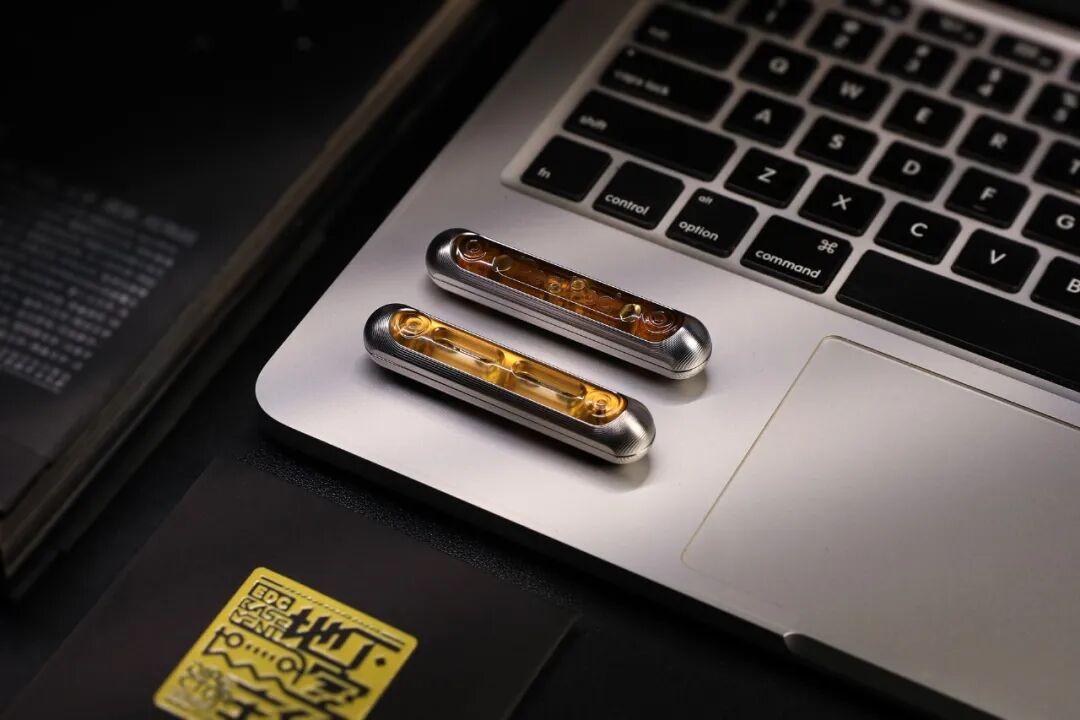 PeaPodBasement Director · Maker image showing two toys.
No matching products.
Families on record Across all brands
Explore the existing catalogue references, including other toy forms and accessories. Open a card to read the recorded details.
No matches. Try another product or brand.
All categories
Category overview →Explore movement, construction and terminology across all six guides.
 Fidget SliderSliding movement, detents and combined play.You are here
 SpinnerSpin, tactile feedback and ways to hold or support a spinner.Read guide →
 Fidget RingTurning feedback, construction and ring dimensions.Read guide →
 Haptic CoinTurning, pressing and different feedback structures.Read guide →
 KnuckleGrip forms, moving parts and feedback.Read guide →
 Knives & ToolsBlade formats, locking mechanisms and everyday tools.Read guide →
Related family guides
Explore the family guide and its documented configurations.
The family guide is currently unavailable. This entry is retained as a catalogue reference.
Explore the family guide and its documented configurations.
Explore the family guide and its documented configurations.
The family guide is currently unavailable. This entry is retained as a catalogue reference.
No family guide is currently mapped to this catalogue entry.
No family guide is currently mapped to this catalogue entry.
No family guide is currently mapped to this catalogue entry.
No family guide is currently mapped to this catalogue entry.
No family guide is currently mapped to this catalogue entry.
No family guide is currently mapped to this catalogue entry.
No family guide is currently mapped to this catalogue entry.
No family guide is currently mapped to this catalogue entry.
Explore the family guide and its documented configurations.
No family guide is currently mapped to this catalogue entry.
No family guide is currently mapped to this catalogue entry.
No family guide is currently mapped to this catalogue entry.
No family guide is currently mapped to this catalogue entry.
No family guide is currently mapped to this catalogue entry.
No family guide is currently mapped to this catalogue entry.
No family guide is currently mapped to this catalogue entry.
No family guide is currently mapped to this catalogue entry.
No family guide is currently mapped to this catalogue entry.
Product photo pending. No family guide is currently mapped to this catalogue entry.
No family guide is currently mapped to this catalogue entry.
No family guide is currently mapped to this catalogue entry.
No family guide is currently mapped to this catalogue entry.
No family guide is currently mapped to this catalogue entry.
No family guide is currently mapped to this catalogue entry.
No family guide is currently mapped to this catalogue entry.
No family guide is currently mapped to this catalogue entry.
No family guide is currently mapped to this catalogue entry.
No family guide is currently mapped to this catalogue entry.
No family guide is currently mapped to this catalogue entry.
No family guide is currently mapped to this catalogue entry.
No family guide is currently mapped to this catalogue entry.
No family guide is currently mapped to this catalogue entry.
No family guide is currently mapped to this catalogue entry.
Explore the family guide and its documented configurations.
Explore the family guide and its documented configurations.
Explore the family guide and its documented configurations.
Explore the family guide and its documented configurations.
Explore the family guide and its documented configurations.
Explore the family guide and its documented configurations.
Explore the family guide and its documented configurations.
Explore the family guide and its documented configurations.
Explore the family guide and its documented configurations.
Explore the family guide and its documented configurations.
Explore the family guide and its documented configurations.
Explore the family guide and its documented configurations.
Explore the family guide and its documented configurations.
Explore the family guide and its documented configurations.
Explore the family guide and its documented configurations.
Thirteen documented complete configurations and seven separate tuning-fork middle plates. Scope and source differences remain stated in the guide.
Compare documented designs
| Design / documented version | Structure | Feedback / action | Documented dimensions | Announced price (date / configuration) |
|---|---|---|---|---|
|
LAUTIE CHOC Check the chosen complete configuration; components and storage are separate |
Modular shell and inner piece; spring-and-ball following a stepped rail | Mechanical detents; the separate magnetic lock retains the shell | Not documented in the reviewed source | Not documented in the reviewed source |
|
LAUTIE Jackpot Original handheld magnetic-axle setup; do not transfer its full construction to the 2.0 Deskset |
Original handheld form with independently rotating number axles; 2.0 also has a Deskset configuration | Magnetic axle feedback; magnet count changes the original handheld setup | Not documented in the reviewed source | Not documented in the reviewed source |
|
WANWU EXOSKELETON Check the chosen complete configuration; components and storage are separate |
Moving block and interchangeable core; a separate track-and-ball setup is also documented | Mechanical steps and magnetic-core impacts in the default mode; track choice changes the feedback | Not documented in the reviewed source | Not documented in the reviewed source |
Examples compare the named documented configuration. Dimensions describe their stated axes. Prices are dated manufacturer-announced offers, not current listings, transaction prices or a whole-family price band. Unknown fields stay unknown.
Archive coverage
For 2026, TRB's imported archive contains 19,267 positive-priced CNY auction results automatically linked to database entries tagged as slider designs. Coverage ends on 31 August 2026; incomplete automatic matching prevents a reliable most-traded ranking.
These are existing KB tag assignments, not independently verified category membership. Unmatched records and unresolved family aliases remain outside these counts. Recorded auction results are not proof of payment, settlement or absence of refund.
Archive checked . How we verify →
Frequently asked questions
Can I identify a slider’s feedback just by seeing magnets?
Magnetic sliders use magnets for their main resistance or detents. Mechanical sliders use physical contact or elastic parts, such as spring-loaded balls following a track. A magnet used for another purpose does not determine the feedback category. All categories
Can I separate or rotate any slider labelled free motion?
No. Free motion describes the absence of the particular fixed end stop, not the absence of feedback. A slider can retain detents, and its permitted displacement, rotation and separation still depend on the product. All categories
Does extra-dense feedback mean stronger detents?
No. Density describes how closely feedback events occur. The 01 extra-dense insert description separates fine vibration from an additional final detent; it does not establish a shared strength scale across brands. All categories
How do I check whether a replacement insert fits my slider?
Shell size, generation and track plates can limit compatibility. Identify the exact shell, insert and required parts, and check whether a listing supplies a complete toy or only a component. All categories
