

Damascus Steel
Damascus steel names patterned steels used in EDC bodies and components, rather than one fixed grade. Pattern, etching and shape affect appearance, while alloy composition and heat treatment depend on the specific material.
Maintained by TRB Creation · Page updated
Patterns first, then the steel, etch and component
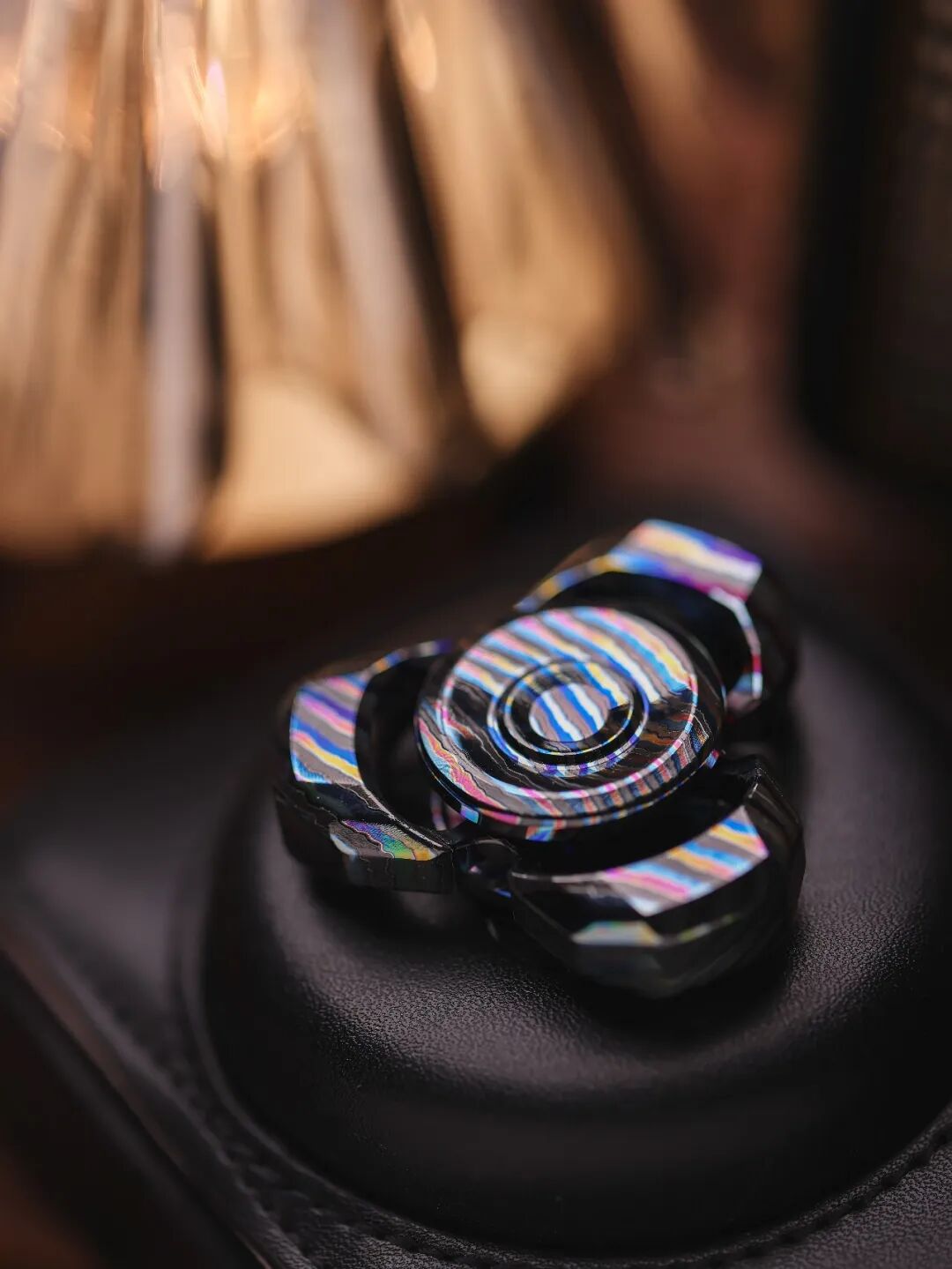
Fate II carries flowing silver-white patterns across its exterior. Zheye spreads its pattern over three curved arms and a centre button. Products described as Damascus can differ in material source, composition and finish.
This guide focuses on steel examples. Titanium Damascus, Zircuti and copper-based patterned materials keep their separate identities.
MH’s Fate II “Mingwang · Yinyao Yuanwen” version. The source identifies its material as Damascus steel.
Fate II: patterns across faces and corners
MH names the Damascus-steel version of its revised Fate II “Mingwang · Yinyao Yuanwen”. In the original photograph, flowing silver-white patterns cross the broad faces, while tighter patterns appear along the edges. Reflections give the surface alternating lighter and darker areas.
The phrase is a product-version name. The article gives no verifiable steel grade, recipe or hardness test, so the name cannot supply those details. Its historical-metallurgy promotion also does not establish the manufacturing route used for this product.
Zheye: the 69 g medium-etch OG version
The Zheye “Damascus medium-etch OG” release photograph. The maker lists 69 g; the visible pattern does not identify a steel grade.
“Medium-etch” renders the release’s surface-treatment wording. It does not specify acid concentration or a standard etching depth. The sale description also mentions a small number of gold-plated surprise pieces; the silver-grey version photographed here should not become a claim that every piece was gold-plated.
The same article separately lists Damascus, titanium Damascus, Zircuti, copper Damascus and ruifen buttons. Changing a button can put a different material at the centre of the spinner, so the body and buttons each need their own material description.
Some releases name both the material and its parts
A Zeus Project update for Kronos names Damasteel DS95X for the armour plates and buttons, paired with polished stainless steel for the other parts. The image in that announcement shows material stock, rather than a completed spinner.
Damasteel’s own documentation describes DS95X as a powder-based austenitic stainless steel made from 304L and 316L alloys. That supports the background for DS95X. It does not establish that another product labelled only “Damascus” uses the same material.
The dedicated Damasteel guide covers the manufacturer’s material series and specific EDC examples. A broad material name, manufacturer, grade, pattern and component describe different levels of information.
Yin St: a face pattern and separate button materials
Btw’s human-face mosaic Damascus edition of Yin St pairs a patterned steel body with polished zirconium outer button rings. The maker describes welding, cutting, stacking and forging pattern units into a steel billet, followed by wire cutting, CNC machining and heat colouring. The standard inner buttons have a spider pattern, and an additional pair is supplied in the same material as the body. These details identify the pattern and configuration; they do not establish an undisclosed steel recipe or hardness.
Read the pattern, then look for performance evidence
These examples place patterned metal on different shapes: Fate II’s long exterior, Zheye’s curved three-arm outline, and the armour plates and buttons previewed for Kronos. Pattern direction, etching and polishing produce different effects within a similar silver-grey palette.
Corrosion resistance, hardness, edge retention and skin-contact behaviour require a specific material, process and test context. Attractive layering in a photograph cannot answer those questions on its own. A material statement paired with the correct version and component is the more useful record.
IN THESE FAMILIES
Swipe to exploreTwo families with identified finished-product photographs show different uses of patterned steel in EDC.
PIECES IN DAMASCUS STEEL
Each example retains the wording and photograph of its particular release; current stock has not been verified.
ALL MATERIALS
Keep exploring the TRB material guides.
 ZircutiZircuti material guideVIEW →
 SuperconductorSuperconductor material guideVIEW →
Material background
Damasteel: DS95X material introduction · 304L/316L powder-based austenitic stainless steel, applicable to this particular material series.
Continue reading: Damasteel Material Atlas · The manufacturer’s material series and specific EDC examples in a separate guide.
Examples in detail
MH · Fate II, revised version
Mingwang · Yinyao Yuanwen · Damascus steel
The source lists this version separately from titanium Damascus, Zircuti and copper Damascus.
The silver-white exterior pattern is visible; the steel grade and exact manufacturing route are unspecified.
NINI · Zheye
Damascus medium-etch OG · advertised weight: 69 g
The pattern follows the three-arm outline and centre button.
Medium-etch is this release’s wording, not a standard etching specification. Separate special-material buttons are also listed.
Common confusions
From Zheye: the 69 g medium-etch OG version
NINI’s material update identifies this Zheye as “Damascus medium-etch OG” and gives a weight of 69 g. Lines follow the three curved edges, with a more concentrated circular pattern on the centre button. This is the appearance of a specific finished piece, not a pattern shared by all Damascus steel.
Common material-name confusions
| Name | Documented distinction | Boundary |
|---|---|---|
| Damascus steel | Patterned steels used in bodies and components; titanium and copper-based patterned materials remain separate. | The broad name does not identify a fixed alloy, hardness or heat treatment. |
| Damasteel DS95X | A powder-based austenitic system using 304L and 316L. The manufacturer says it cannot be hardened by heat treatment. | That supplier specification does not establish DS95X in a product labelled only Damascus or ruifen. |
| Damasteel DS93X | A separate martensitic system using RWL34 and PMC27, with its own hardening and tempering conditions. | Heat-treated knife hardness is not a property assigned to every ruifen spinner. |
| Titanium Damascus / Mokuti | The atlas uses Titanium Damascus as an explanatory name for Mokuti / taima. | The shared word Damascus does not make it the same material as patterned steel. |
Frequently asked questions
Is every Damascus-steel fidget made from the same stainless steel?
No. Damascus steel is not one fixed grade. Damasteel describes DS95X as a powder-based austenitic stainless steel using 304L and 316L; that description applies to DS95X. It does not identify every product called Damascus, or establish the composition and corrosion behaviour of a piece whose steel is unspecified. Powder Damascus systems
Can a Damascus pattern tell me how hard or wear-resistant the part is?
No. A visible pattern and a product-version name do not supply a steel recipe, hardness test or heat-treatment record. The material, processing and test context must be identified separately. The guide leaves those properties unknown for examples whose sources do not document them. Grade and heat-treatment differences
